Free Trade Agreements

1.1 – The basics of trade agreements

There are two major types of trade agreements: free trade agreements (FTAs) and foreign investment promotion and protection agreements (FIPAs).

Free trade agreements

Free trade agreements focus on lowering or removing the tariff barriers that hamper trade in goods between countries. This helps increase joint trade, which strengthens the economies of the partner countries and improves the lives of their citizens.

Foreign investment promotion and protection agreements

These agreements protect investors from harmful actions by a local government, such as expropriation. They can help promote foreign investment in a country and ensure a stable environment for investment flows. This can encourage the economic growth and increase the prosperity of both partners to the agreement.

How free trade agreements work

The basic goal of a free trade agreement is to reduce the tariffs on the goods manufactured in one country and sold in another. Depending on how they’re negotiated, they can also cover non-tariff barriers such as quotas, product standards, labour mobility and intellectual property. Free trade agreements can be between two countries, such as the Canada-Korea Free Trade Agreements, or among three or more countries, such as the Canada-United States-Mexico Agreement (CUSMA).

Free trade agreements may also regulate investment among the partners so that the rules are the same for investors from all the member countries. If an agreement includes such investment rules, it may provide the same types of investor protections as a FIPA.

If you’re a Canadian company looking to sell internationally, a trade agreement between Canada and your target market can make it easier for you to do business there. Depending on your sector and on the specific provisions of the FTA, the agreement may help you compete as an equal with local firms—for example, by eliminating import tariffs on your goods, which helps you compete on price in the local market.

Canada has a free trade agreement with several countries and negotiations for several more are continuing. For full details, you can refer to the Trade and Investment Agreements section of the Global Affairs Canada web site.

ecobee’s smart thermostat

Aerial view of Toronto’s skyline.

Toronto entrepreneur Stuart Lombard didn’t set out to create a market-disrupting product. He wanted to reduce his own environmental footprint and ended up creating a smart thermostat used by thousands of households in North America.

From the beginning, ecobee pursued a North American strategy, selling its smart thermostat in Canada and the United States, which accounts for about 90% of sales. “The U.S. market for a Canadian company is relatively easy to crack,” says Lombard. “The U.S. has few regulatory or trade barriers, thanks to arrangements like the Canada-United States.-Mexico Free Trade Agrement. It is close to home, has a similar culture and shares the same language.”

1.2 – The benefits of a free trade agreement

Doing business in a market that has a trade agreement with Canada can provide you with numerous advantages, from preferential tariff treatment to easier business travel.

Tariff reduction or removal

A free trade agreement may eliminate or reduce tariffs as soon as the agreement comes into effect, or it may lower or phase them out over time. Either approach can provide these benefits:

  • If the agreement’s tariff provisions apply to your product, you can offer a lower price for your goods in that market. This increases your competitiveness and consequently your sales and profits.
  • If you’re not already doing business in a country, the agreement might make it a highly viable new market for you. This gives you an opportunity to expand your global customer base and increase your international sales.

For example, the Canada-European Union (EU) Comprehensive Economic and Trade Agreement (CETA) eliminated EU tariffs on 98% of Canadian goods immediately when it came into effect in 2017. Tariffs on a select few categories of Canadian food and agri-food products, such as meats and grains, will be phased out over seven years. Similarly, under the Comprehensive and Progressive Agreement for Trans-Pacific Partnership (CPTPP), tariffs on imports of Canadian-made vehicles and auto parts will be phased out over 12 years.

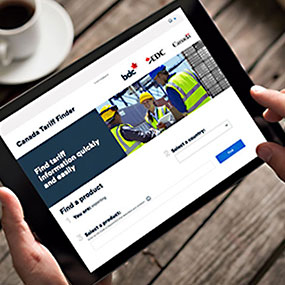
Tablet screen with Canada's Tariff Finder application

The Canada Tariff Finder

The Canada Tariff Finder is a free tool that allows you to check the tariffs applied to goods in an international market. The focus is on countries where Canada has free trade agreements in place. The tool will help you:

  • Easily compare tariffs between export markets
  • More accurately forecast expenses
  • Better assess the profitability of selling to different markets

Easing of non-tariff trade barriers

Non-tariff trade barriers are also common in international trade. Many, such as technical standards for products or licensing requirements, provide safeguards against dangerous or substandard imports. However, they can also serve as trade barriers by being so stringent that you find it difficult to comply with them, putting you at a disadvantage in the local market.

When you’re evaluating an agreement, check to see whether it eliminates or reduces any of the major barriers that might affect your products in the local market. This can increase your competitiveness and make the market a more attractive place for you to do business.

The major non-tariff areas to look for include:

  1.      Quotas: Governments sometimes impose restrictions on the amount of a commodity or class of good that can be imported over a specific period. A free trade agreement may remove quotas that may have previously applied to your products, but not always. Sometimes an agreement may keep quotas in place with certain restrictions. For example, the Canada-EU trade agreement specifies quota limits for European imports of a few classes of Canadian goods such as vehicles and auto parts. Canadian exporters of these goods must apply for an export license to have their goods counted as part of the annual quota.
  2.      Licensing: Some goods can only be imported if the importer has a licence. By limiting the number of licences or making it difficult to get one, a government can restrict imports of the product. By reducing the licensing requirements applied to your goods, a free trade agreement can make it easier for local importers to buy from you.
  3.      Customs clearance: Slow, complex and expensive customs processes can amount to a trade barrier in themselves. Free trade agreements often attempt to streamline these processes or even eliminate some of them. 
    For example, a Canadian exporter may be unsure if their goods comply with the rules of origin in a trade agreement that would allow the goods to receive favourable tariff treatment. Both CETA and CPTPP have provisions that allow for Canadian exporters to apply for an advance ruling from the importing country’s customs authority before they ship their goods.
  4.      Over-stringent regulations and certification standards: By applying unnecessarily stringent regulations and certification standards to foreign products, a government can make compliance so difficult that you can’t operate in the market. A trade agreement can make it easier for you to comply with the regulations and gain market access.
    For example, the chapter on Technical Barriers to Trade in CPTPP includes a section on conformity assessment. The section requires that each country must regard a conformity assessment body in one country no less favourably than a similar body in its own country. That means if a Canadian exporter’s product has been approved by the Canadian Standards Association, that approval must be recognized in all countries that are party to the CPTPP.
  5.      Entry taxes and other charges: Entry taxes, which are typically used to help cover the port of entry’s infrastructure costs, can be manipulated to make imports more expensive. Additional taxes and surcharges can also be imposed for the same purpose. A free trade agreement may reduce or even eliminate these barriers.
  6.      Changing product classifications.: A product’s classification is used to determine the amount of duty to be paid on it. By changing the classification from a low-duty to a high-duty one, customs authorities can make a foreign product locally uncompetitive. A free trade agreement may prevent them from doing this.

Improved access to overseas resources

If you do business in one of Canada’s free trade partners, you may get easier access to lower-cost raw materials, components and other inputs for your manufacturing needs. You may also be able to use international expertise more easily and benefit from easier knowledge transfer. The presence of the free trade agreement, with its preferential tariffs, should also help you connect with the local and regional supply chains that feed into and out of the trade agreement partner.

Affiliate access to other markets

If you establish an affiliate in a country that has a free trade agreement with Canada, and that country has trade agreements with other countries, your affiliate will enjoy all the advantages of those third-country trade agreements as well. When you set up an affiliate in Mexico, for example, your Mexican company will have tariff-free access to Mexico’s 61 free trade agreement partners—a market representing well over half of global GDP.

Better access to government procurement contracts

Governments can use discriminatory procurement practices (by favouring local suppliers when tendering contracts, for example) to keep competitors out of the market. Some free trade agreements include clauses that prevent such discrimination. This may allow you to bid on local government contracts at the national and sub-national levels.

Easier services exporting

Many countries impose tight restrictions on how international service providers can operate in the local market, or even prevent them from operating there at all. This is often done by setting up stringent certification requirements that govern how the service will be provided and who can provide it. But if a trade agreement covers services as well as goods, it can allow Canadian companies to provide financial, legal, educational, engineering, transportation, environmental and other services in the local market.

Simplified business travel

A free trade agreement can simplify entry procedures for Canadian businesspeople and may also reduce or eliminate restrictions on how, when and how long the company’s employees can work locally. This last can be especially important for service companies whose people often need to travel to the market.

Lower risks

Using free trade agreements can help you diversify your markets, which reduces your exposure to economic, financial and supply chain risks. Some of Canada’s trade agreements also include FIPA-like protections for companies that invest in the market. This lowers investor risk by ensuring that the local government treats you in the same way it treats local investors.

1.3 – Should you use a free trade agreement?

The basic goal of a free trade agreement is to help companies do business more easily in international markets. But just because Canada and another country have an agreement, it doesn’t necessarily follow that the market will suit your company’s needs and strengths. The free trade agreement may be one factor in deciding whether you should enter a market, but it shouldn’t be the only factor.

If you haven’t paid much attention to a particular market, though, you might want to look at it more closely if Canada has a trade agreement with the country. This might reveal unexpected potential for exports or investments, depending on how the agreement’s provisions apply to your sector.

If the potential is there, the next step would be to determine whether the market is a good fit for your international business strategy in other ways. For example, you’ll need to:

  • Find out whether there’s any demand for your product or service, and whether the demand is large enough to justify entering the market.
  • Identify potential customers—who they are, where they are, and exactly what they are looking for.
  • Identify potential partners who could help you take advantage of the market’s opportunities and share its risks. This can be especially important for smaller companies that don’t have the resources to do everything themselves, from licensing their technology to distributing their goods. Having a local partner can make it much easier to do business in a market, with or without a free trade agreement.
  • Visit the market to find out how the local business environment works, and to develop relationships with potential customers and partners.
  • Assuming you decide to enter the market, identify your best entry strategy. Will you sell directly to customers there? Use intermediaries such as agents or distributors? Set up a branch office? Partner with a local manufacturer to produce your goods?

Top tips for evaluating intermediaries

Depending on your market, it may be advantageous to use an agent or distributor to sell locally. These intermediaries can help you find customers, manage logistics, handle customs clearance and provide after-sales service.

Distributors purchase your product from you and then sell it on to local buyers. Agents are individuals or firms you hire on commission to sell your product into the target market. When choosing either kind of intermediary, evaluate them by asking questions like these:

  • Do they have the marketing knowledge, industry expertise, financial capacity and facilities (such as showrooms, staff and warehousing) required to represent you properly?
  • Do they know the local laws pertaining to imported goods, such as customs regulations, import documentation, tariffs and standards?
  • Are they motivated to develop new markets and new customers for you? Can you be comfortable working with them?
  • If they represent products that compete with yours, how will they resolve this potential conflict?
  • If they are distributors, do they have a reputation for paying their suppliers promptly?
  • Have you checked their reputations, and have you obtained and verified their references?

1.4 – Implementing a trade agreement strategy

Before you assume that a free trade agreement will work in your favour, you must find out whether its provisions will apply to what you want to do in the market. This question comes up because not all agreements are created equal. Some eliminate tariffs, for example, but ignore non-tariff barriers such as standards and regulations.

To decide whether the agreement will give you a real advantage, start by examining the text of the agreement itself. Here are some things to look for:

Tariffs

If the agreement eliminates or reduces tariffs on your goods, will this help you get enough market share to justify going there? Could your competitors offer something you’re not?

Product compliance

Does the agreement include provisions that make it easier and cheaper for your products to comply with local standards and regulations? How does this contribute to your bottom line?

Service personnel qualifications

If you’re a service company, does the market recognize the Canadian qualifications of your service personnel under the agreement? Does this make it easier to for you to send them there? Would it be better to set up a local affiliate to provide your service?

Rules of origin

Will complying with the agreement’s rules of origin give you favoured market access compared to your competitors? Will this translate into more market share?

Direct investment

Does the agreement have investment provisions that level the playing field for both local and international investors? Will this allow you to compete? If some sectors of the local economy don’t permit international investment despite the agreement, would this apply to your company?

Given how complex the provisions of an agreement can be, you may find it difficult to find complete answers to these questions. It is highly recommended that you use outside accounting and legal expertise to get all the information you need.

1.5 – Free trade agreements and compliance risk

Using a free trade agreement to help you succeed internationally isn’t generally risky. That said, doing business in a country that has a trade agreement with Canada can raise the possibility of compliance risk.

This is an issue if you take advantage of an agreement’s benefits but don’t comply with the rules that apply to your sector and your type of company. If you are deemed non-compliant by the local customs authority, you could receive penalties ranging from severe fines to the loss of your goods.

Canadian twenty dollar bill goes further when tariff barriers are removed through FTAs

One way to lessen this risk is to build relationships with your customers and partners. They can help you deal with things like product labelling and standards requirements. Working with customs brokers can also be useful since they have a stake in ensuring that goods move smoothly across their borders and attract no penalties. For a broader look at compliance and how to manage it, you can refer to EDC’s online guide, Playing by the Rules: Compliance in International Trade.

Keep in mind that trade agreement rules can be very complex, so you should always obtain professional advice about how they’ll apply to your company. You can also refer to sources such as the Canadian Border Services Agency, the Standards Council of Canada, the Trade Controls and Technical Barriers Bureau and the Canadian Trade Commissioner Service.

Top do’s and don’ts for using free trade agreements

Do

  • Assess whether the agreement’s provisions apply to your products or services.
  • Ensure that you comply fully with its rules.
  • Build relationships with your customers and partners.
  • Use expert help to assess your overall free trade agreement position.

Don’t

  • Make a free trade agreement the sole reason for entering a market.
  • Neglect your market research just because there’s an agreement in place.
  • Depend solely on an agreement to keep you competitive.
Date modified: 2018-12-28