International networks in context

1.1 The importance of developing international networks
In today’s digital age, rapid advancements in technology have resulted in a world that is flat – a level playing field for companies, regardless of borders and size.

In this era of globalization, you can find a new customer, in any part of the world, with the click of a mouse. However, so can your competitors. The key to being successful in the global economy is developing a global competitive advantage (GCA) over your competition. Developing strong international networks – specifically, strong business-to-business (B2B) relationships in your market of interest – can give you an edge.           

“Developing solid relationships through networking is the new currency of the global economy,” explains Alejandro Rojas, international trade consultant with MSquare, based in Mexico. “Enhancing your Rolodex with the pertinent contacts in a specific market can set you apart from your competition.”

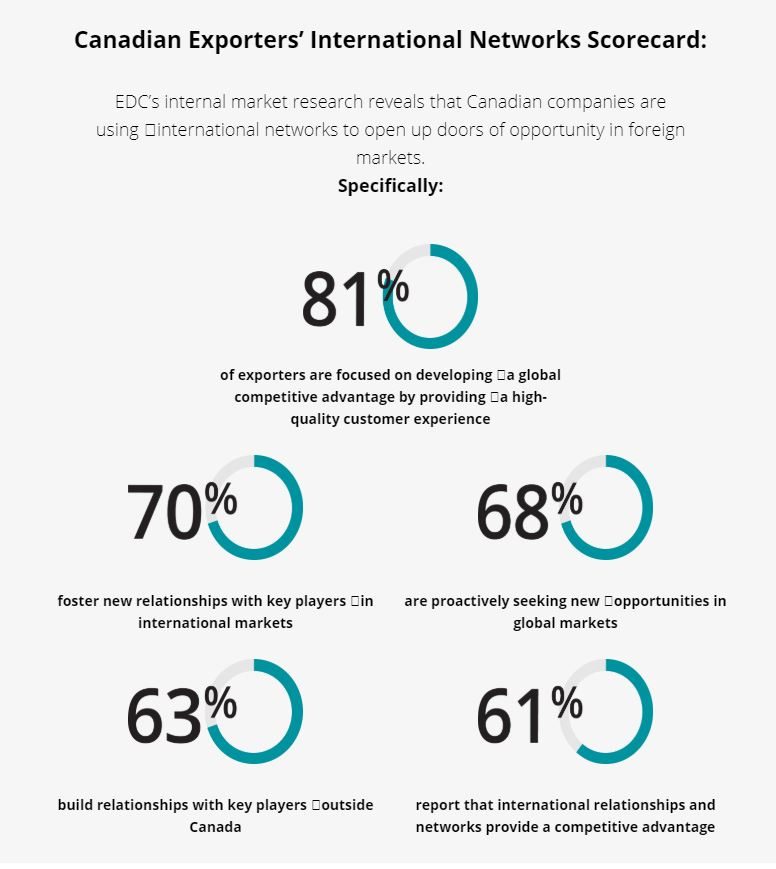
international-markets-infographic

International networks help you:

  • Find new customers

The Canadian market may be lucrative for domestic companies, but it is a small market and the growth strategy for many Canadian companies includes global expansion – to the U.S. and beyond.

The overall goal of “going global” is to expand your reach and find new customers in international markets. However, this can be difficult, or almost impossible, without an established international network.

  • Meet agents/distributors

One way to take your product or service to a new market is through an agent or distributor. An agent is an individual or firm you employ to sell your product in the target market. Alternatively, distributors purchase your product from you and then sell it to their customers.

Want to know more?

For detailed information about finding new customers, download EDC's whitepaper Finding New Customers.

  • Develop new partnerships

Having the proper contacts with the needed market intelligence can overcome many barriers to market entry. Developing these relationships, whether formal or informal, are crucial to your success.

Want to know more?

For detailed information about developing new relationships, download EDC's whitepaper Finding, Training and Managing International Agents and Distributors.

International networks are becoming more important, complex and integrated in today’s rapidly-changing global economy. While developing strong linkages in a specific market is critical to a company’s success, you can't just pick a country and expect to do business there without conducting the pertinent research. Like doing business locally, success in a foreign market depends on developing strong relationships.

1.2 Best practices

How are Canadian companies developing international networks? Research. Understanding the sensitivities, language and culture of your market and the marketability/saleability of your product or service are important to any export plan, but so is a solid market-entry strategy.

“There are many ways to enter a market, and each strategy’s pros and cons must be fully considered, be it direct sales, working with an agent or distributor, a joint venture with another company, e-commerce, or direct investment,” says Mélanie Carter, Knowledge Partnerships Lead at EDC. “In addition, the different languages, cultures, ways of doing business, consumer preferences, and regulations will play a role in choosing the optimal market-entry strategy.”

EDC internal market research reveals that successful companies on the global stage are adopting a few common best practices to develop international networks.

1) Leveraging strong financials 

According to EDC’s internal market research, 40% of Canadian exporters leverage strong financials to attract new clients and opportunities. A positive balance sheet is a way to attract new clients or opportunities, as it demonstrates that your company is successful, with a  good client base.

2) Building relationships with key industry-specific players

Developing relationships with domestic as well as international industry companies/players can help expand networks. If a Canadian company is already conducting business in the market you are targeting, they can introduce you to their contacts and provide invaluable insight from its experiences. Alternatively, developing a relationship with foreign companies in a particular export market can also provide much-needed assistance for market entry. Domestic trade associations are also an excellent resource as they will have domestic companies as members who are exporting around the world and who can provide invaluable information to assist you on your export journey.

3) Proactively seek out new opportunities 

This may seem pretty straightforward, but research by the trade association Canadian Manufacturers & Exporters (CME) consistently demonstrates that two of the biggest challenges Canadian companies face when selling abroad is lack of customers and knowledge of markets. In 2017, 32% of Canadian exporters cited this as the most pressing challenge.1 That’s inline with EDC internal research that reveals 29% of exporters cite connecting with customers as a major obstacle to doing business internationally.

Furthermore, a 2018 Canadian survey of industrial exporters divulges that just 45% of companies say they did enough upfront research before diving into a new export market.2

Research is critical to global success. The internet is a wealth of information to provide a foundation, but successful companies take it to the next level. They talk to companies who are in the market already for advice and are aggressively looking for possible partnerships to promote their products and develop international sales.

1.3 Why international networks are critical to success

Success in foreign markets hinges on finding new customers, intermediaries and partners – the result of successful networking. All companies have networks, whether domestic or international, but leveraging the capabilities of those networks can translate into business success.

Networking is the most common method that exporters use to create business-to-business (B2B) relationships with foreign companies. It typically draws on trade shows, recommendations from other businesses, connections with industry organizations and associations and in-market visits to establish personal contacts with local decision-makers.

And developing a solid network is crucial because, as a foreign company, you are competing with domestic businesses that have the advantage of a solid understanding of customers’ needs, the language, culture and business customs. While you can learn a lot about the way business is conducted in a country on the web, there are subtleties in some markets that can only be completely understood by experiencing them.

“I tell each of my clients that if you want a competitive advantage in a specific market, get on a plane, visit the market, learn about it and develop as many contacts as you can,” says Rojas.  “To be successful, you really have to understand the market nuances, your customers and how you can do better than your competition. You need to get a taste of the market and you’re not going to accomplish that through Google.”

Getting a taste of the market helps define your market entry strategy, which can often be quite challenging to develop, since it raises questions of logistics, distribution, in-market sales approaches and whether to use local representation.

In non-English speaking countries, leveraging your network, specifically on-the-ground expertise, is crucial to success, according to Mel Sauvé, president of Burlington trade consultancy Global Growth.

“The fundamental issue a number of Canadian companies face is finding an agent, a sales representative or a partner when looking to expand into a new market,” he says. “In any non-English speaking country, you pretty well have to work with a partner.”

CASE STUDY 
CHINA: where culture is key

china-business

China is a very challenging market for North American companies. Back in the 2000s, companies tried to establish a market presence there but were unsuccessful, mostly because of drastic differences in culture, business values, language and overall customs.

According to the Canadian Trade Commissioner Service (TCS), China is Canada’s second-largest export market and the world’s largest market for cars, cell phones and seafood, as well as the fastest growing market for luxury goods, air passengers and nuclear power.

The country “boasts the most internet users and online game players, the longest high-speed rail network and the busiest port. There are more than 100 cities in China with a population of more than one million and, according to the Economist Intelligence Unit, the economy will grow at rates of about eight per cent per annum for the next decade.”3

Local presence is a must

To do business with China, you need to be there – to seize opportunities and maintain control. The TCS pinpoints 400 Canadian operations on the ground in China – most of which came to China in the past 15 years in an effort to source cheap products or inputs. As volumes grew, they opened representative offices and eventually started to manufacture for export.

“Today, most of these firms are focused on selling to China’s domestic market. And to be successful in this business, you really need a local presence,” highlights the TCS website.4

Culture

This is one area that is dramatically different than western economies.

Dr. Broderick Martinez, a professor at Kaplan University, explains in a 2017 article on doing business in China why exporters need a sensitivity to Chinese culture and an understanding of how its business impact.

“Hierarchy plays an integral part of business culture in China with leaders and managers being more distinguished than in many Western countries,” he reveals.5

Dr. Martinez also highlights the importance of the concept of face.

“Face represents a person’s reputation and feelings of prestige within the workplace, family, friends, and society. For instance, an American subordinate attending a meeting where his/her boss is making a presentation would generally not think twice about asking a question, making an alternate suggestion, or even disagreeing with something. In China, this would be a serious face-losing situation for the subordinate, boss, and even the company. Not pointing out others’ mistakes and giving credit for others’ good work are both good ways to help others save face,” he adds.6

As a Westerner, it’s also important to show respect.

Dr. Martinez adds: “Giving gifts, accepting invitations, acknowledging hierarchy, addressing people by their designation, attending meetings, and showing genuine interest in the local culture are ways to show respect in China.”7

Business moves at a slower pace than Canada

Doing business in China often takes longer than it would in most Western countries. Many foreign companies are unsuccessful because they don’t have the required patience to effectively navigate the Chinese market, nor understand the importance of developing long-term relationships.

As Dr. Martinez highlights: “It is important for Westerners to understand they may need to meet with Chinese businesspeople multiple times before a business partnership or deal can be made. If Westerners are invited to drinks or a meal, it is vital to the development of the relationship to go.”8

Home Depot fails in China

While a foreign market like China can be challenging for small- and medium-sized enterprises, large multinational corporations aren’t immune from poor decision-making.

Fuelled by a building boom in the country, Atlanta-based Home Depot decided that to enter the Chinese market in 2006. After opening 12 stores, the American company learned a very key fact about the Chinese – they don’t view do-it-yourself home improvement as a hobby. Rather, it was seen as a sign of poverty.

Home Depot closed all its stores by 2012, recording losses of more than $160 million (US).

SUMMARY: International networks in context

  • International networks are a key tool for Canadian companies hoping to uncover opportunities in global markets
  • Networks help you: Find new customers, meet agents and distributors and develop new partnerships
  • But companies hoping to build international networks need to do their homework
  • Best practices include: Leveraging strong financials, building relationships with key industry-specific players and proactively seeking out new opportunities
  • Doing the proper research is important to understand how local customs and business norms differ from ours. For example: in China
Date modified: 2019-01-23