Finding innovation
Innovation has never been more important for Canadian companies than it is right now. Why?
Because competition has never been fiercer than it is right now. A finger tap or mouse click is all that separates customers from products and services around the world. That means companies that fail to deliver a unique selling proposition will quickly find themselves replaced with a competitor – even ones that are in other countries.
For Canadian companies looking to compete in the global economy, continual innovation is key to developing a unique selling proposition and maintaining relevance.
In this e-book we’ll examine how companies can boost innovation at their company, knock down barriers to innovation and conquer age-old problems around getting ideas to market.
In this chapter
Innovation means creating value for your customers through continuous improvement of your product.
If you are doing business the same way you were five years ago, you are in trouble. If you plan on doing the same things you are today in five years’ time, you will be out of business
Innovation takes many forms
Here’s how the Organization for Economic Co-Operation and Development’s Oslo Manual for Measuring Innovation breaks the term down:
- Product innovation: A good or service that is new or significantly improved. This includes significant improvements in technical specifications, components and materials, software in the product, user friendliness or other functional characteristics.
- Process innovation: A new or significantly improved production or delivery method. This includes significant changes in techniques, equipment and/or software.
- Marketing innovation: A new marketing method involving significant changes in product design or packaging, product placement, product promotion or pricing.
- Organizational innovation: A new organisational method in business practices, workplace organisation or external relations.2
Here are some of the foundational elements of innovation.
Investing in research and development
Investing in developing new products or improving existing ones can help a company carve out a competitive advantage in the global economy.
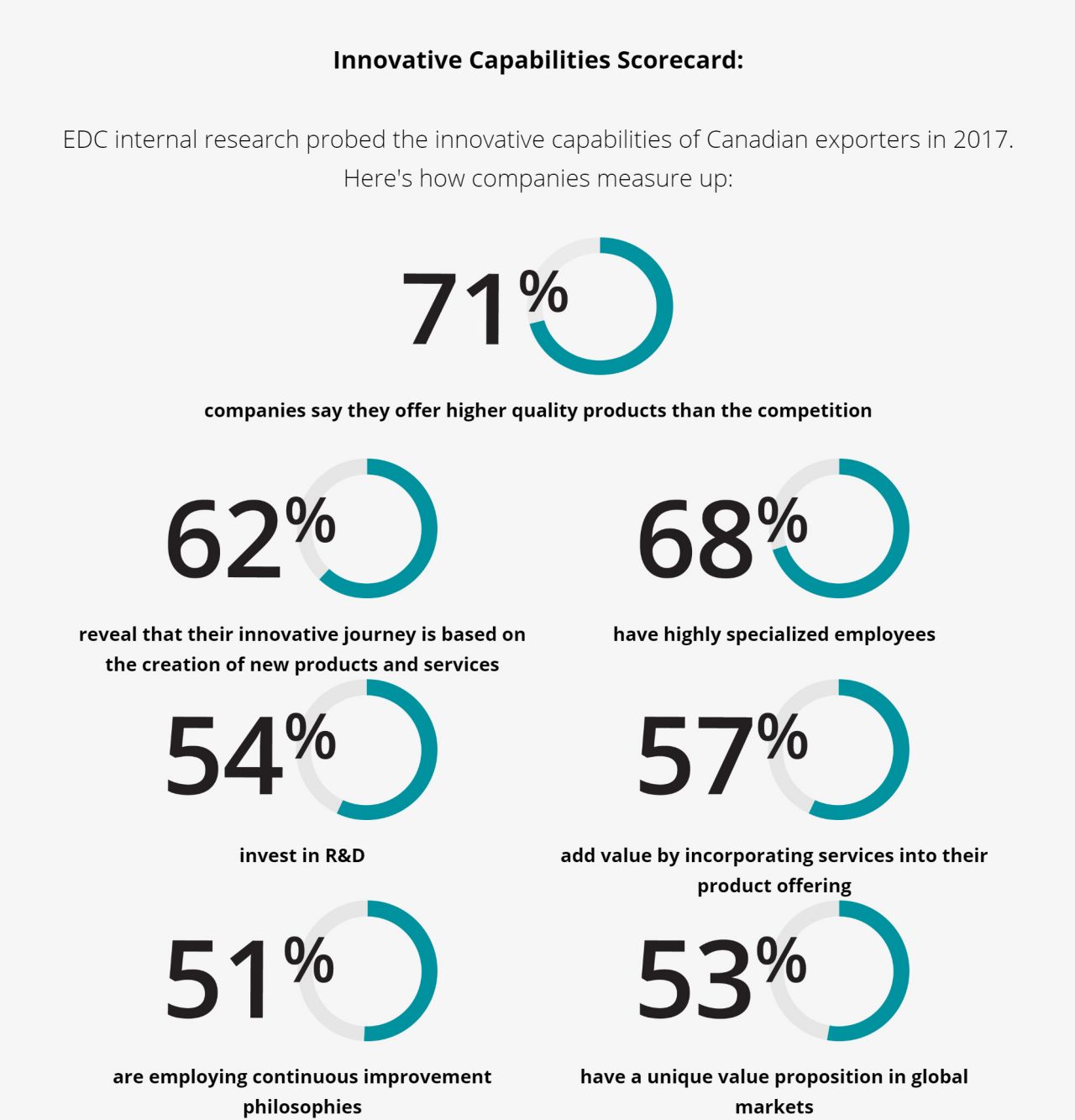
Internal EDC research reveals that 54% of Canadian exporters invest in Research and Development (R&D).
But R&D can’t just be spent on anything. It needs to be closely tied to a business’s growth strategy, with a particular eye toward innovation.
This is where it can be helpful to segment innovation into two separate types – sustaining and disruptive.
- Sustaining innovation: This happens when companies add incremental value to a product or service. Here a company gathers feedback from its customers on what their needs are, then incorporates solutions for those needs into its offerings. Example: A drug manufacturer that continually augments its products with new ones that deliver value to the customer.
- Disruptive innovation: This is where companies create products or services that introduce entirely new markets, while (usually) doing away with others. Example: Netflix’s solution for quick, cheap and easy online video streaming revolutionized the way users consume content. Customers could, with the click of a button, access thousands of movies, TV shows, and documentaries. This made old video consumption business models – such as Blockbuster Video’s – obsolete.
This is where it helps to break out of the thinking that puts your company in the product or service category. What you want is a solution that delivers value to your customers – it shouldn’t matter if it’s labeled a “product” or “service”.
My advice to clients is not to think like you are selling a product, act like you are selling a customized solution that bundles products and services into one value-added package, Customers are demanding it, so you need to meet that demand or someone else will.
The bottom line is that you want to be unique in the marketplace and offer customers a complete, turn-key solution.
Invest in new markets
There are a lot of benefits to investing in new markets.
Increasing sales and profits.
Getting closer to customers.
Improving competitiveness.
But improving innovation is perhaps one of the most overlooked.
Investing in new markets gives your company access to new supply chains, technologies and resources – all of which are key methods of innovating.
Research by EDC reveals that 47% of all Canadian exporters invest in new markets while further internal data highlights that making foreign investments like setting up a local sales office can result in more sales, lower costs, greater productivity, improvements in market penetration and increased competitiveness. The data also shows that most of these firms consider these investments a success.
And the good news for Canadian companies? Opportunities for investing in new markets are on the rise.
Approximately 73% of Canadian exports are destined to the United States. More than 70% of the global growth the next few years, however, will be generated from emerging economies. It’s estimated that China and India will account for 40% of that growth, creating a number of opportunities for Canadian companies.
EDC market data indicates that more than half of Canadian exporters (56%) are currently doing business in emerging markets – a trend EDC Vice President and Chief Economist Peter Hall says has grown over the past few years.
“In a relatively short time span, our trade with this rapidly-rising part of the global economy has risen from less than 5% to almost 13% of our merchandise exports,” he says.3
Want to know more?
To learn more about developing a skilled, diverse team, read EDC’s e-book on skills Beyond Exporting: Building or Buying International Operations.
Continuous improvement: Challenging the status quo
Challenging the status quo is a mentality endemic to many of the world’s most innovative companies.
Tesla CEO Elon Musk believes that the best advice he can offer any company, regardless of size, is to constantly think about how you can do things better. Sounds simple, but streamlining internal operations, eliminating waste and an overall focus on continuous improvement are not merely processes. They’re a culture.
One example of continuous improvement is the lean business mantra, which was originally created by Toyota and derived from its Toyota Production System (TPS) to eliminate waste and inefficiency in its manufacturing operations. Since 1948, the TPS has evolved into the broader lean philosophy that can be applied to any business looking to improve efficiencies by driving out waste in operations while enhancing customer value. Adopting lean principles is critical for Canadian companies looking to be competitive against lower-cost nations in the global economy.
It’s also one way they can adopt innovative policies that puts them ahead of competitors.
State-of-the-art workforce
Many of the stereotypes about innovation revolve around technology – introducing the latest widgets and products so we can deliver faster and more efficiently. But we frequently overlook the most important catalyst for innovation: People.
“The workforce behind every business and organization operating today continues to be the greatest asset available in carving out a competitive edge,” said Claudio Prado of the international law firm Baker McKenzie.4
Attracting and retaining top-notch talent that not only possesses the skills to meet day-to-day challenges, but thrives on creativity and innovation that will drive a company into the future, are necessities. According to a 2016 World Economic Forum Report, creativity will be one of the top-three in-demand skills by 2020 and beyond.5
Technology
Having great people is important. But it’s not enough.
Companies also need to stay on top of the latest technologies.
That’s why companies need to equip their workforce with the tools necessary to stay on top of them. Otherwise they’ll quickly find themselves falling behind – not only in the fight to attract top customers, but the fight to retain top talent in their workforce.
Social. Mobile. Applications. Analytics. The cloud. The Internet of Things. Those aren’t just merely six buzzwords, but rather the catalysts fuelling the digital disruption of the global and Canadian economies, a technological revolution being dubbed Industry 4.0.
Embracing and finding new ways to utilize technology to work smarter and faster is a must-have in the highly competitive global arena.
Technology, particularly the Internet of Things (IoT), is already transforming the way business is conducted around the globe by eliminating borders, altering supply chains and overall international trade, while empowering companies to find new business partners as well as suppliers from the click of a mouse or the screen of a smartphone. However, that also translates into increased competition, reinforcing the need for Canadian companies to incorporate a technology strategy to assist with creating their global competitive advantage.
Customers first, customers always
Price is an important factor for consumers. But Canadian companies cannot compete in the global economy on price alone because customers are more demanding than ever. In fact, EDC market research highlights that 59% of Canadian exporters report price advantage as the main challenge in global markets. As a result, competition is stiff.
That’s why product differentiation, mass customization and the inclusion of value-added services – all with the intent of providing a solution to your customer – are critical to success, Cogent’s Ron Harper explains. “It’s been very important to us to develop a value proposition that includes helping our customers. If the value we provided was based solely on cost, we wouldn’t be in the position we are in today,” he says. That all starts with adopting an innovative attitude toward addressing customer issues. Companies that can’t differentiate on price will need to ensure their products and services are more valuable than the competition’s.
- A big part of being innovative is understanding the concept in the first place. Innovation is anything but business as usual – it’s a process of improvement that’s essential to competing in the global marketplace
- Investing in research and development (R&D) is an essential component of innovation
- Investing in new markets is a key pillar of innovation for many companies
- Continually challenging the status quo – both internally and externally – through ideas such as the lean business mantra help eliminate waste and inefficiency
- Attracting and retaining top talent is a key component of introducing innovation at a company
- Putting the customer first – through product differentiation, mass customization and the inclusion of value-added services – is critical for innovation
CASE STUDY:
Sustaining innovation leads to new customers for Automatic Coatings Limited
In the highly competitive powder coating market, ongoing research and development is a key ingredient in the recipe for global success. That’s why it’s been part of Automatic Coatings Limited’s business mantra the past 50 years.
The company initially developed a niche rewiring electric motors, but soon realized that it could expand its service offering insulating the motor armatures with powder coating.
The Toronto-based company’s commitment to innovation has resulted in ACL perfecting many powder and liquid coating techniques originally used on household appliances to become the leading industrial corrosion applicator in North America.
“The name of the game for us is innovation,” says Vice President Jocyelyn Bamford, “We’re constantly reinventing what we do here out of necessity.”
That was never more apparent than during the Great Recession of 2008 – a turning point for the company. With the automotive supply chain in North America under extreme pressure and many companies moving production out of Canada, it was a great blow to the business and time to shift the innovation gear into overdrive.
“We looked at what isn’t easily moved offshore and quickly realized that pipeline coating was a growing industry,” she adds. “We've grown steadily through innovation and because we're fortunate that we’ve developed patents and new technologies that have helped us continue to grow.”
Today, the company has patents in the pipeline, mining and marine sectors and does work for the Canadian and U.S navies. One of its competitive advantages is the ability to perform in-field coatings for pipelines in Western Canada. Its technology developed for the mining industry has a global footprint as many Canadian companies operating around the globe, specifically South America, have relied on ACL’s proprietary innovation to extend the life of a mine plate. In addition, Automatic Coatings has branched into building equipment to sell to different Navies worldwide to extend the life of their parts and reduce maintenance cost.
LEAN CASE STUDY:
Cogent leans out supply chain
Burlington’s Cogent Power has embraced lean throughout its business operations. The manufacturer of electrical steel-grade components began its lean journey more than a decade ago and today leverages it even further by providing lean training to customers to help them streamline their operations.
Cogent also applies lean principles in its global supply chain. While not easily done, it’s an area that President and CEO Ron Harper says more companies should focus on to improve overall profitability.
“[Leaning out the supply chain] was a real challenge,” he says. “Steel mills like to send you boatloads of material, and on-time delivery means they shipped it during the month you asked for it.”
Harper and his team worked with all of Cogent’s suppliers to develop a pull system – a manufacturing system based on actual daily demand.
“It took a very long time; it took a lot of education and it took a lot of energy on our part to make sure there was a shared value created,” Harper adds. “It’s made a huge impact on the amount of inventory investment we make.”
The company also worked with its MRO (maintenance repair and operations) suppliers as well. It instituted what it describes as “Kan Cams” on all of its incoming supplies. Like a supermarket process for everything from mallets to metal banding and other maintenance supplies, the process creates real-time inventory levels. Cogent’s suppliers have direct video feeds on all of the company’s supply bins and once each gets reduced to a specific level, the suppliers know it’s time to replenish.
Not all of its suppliers bought into Cogent’s value proposition. One pallet supplier wanted to send the company a truckload of pallets every day, whether it needed it or not.
“That didn’t work for us, whatsoever,” adds Harper.