Basics of e-commerce success
E-commerce technology is now so sophisticated that you can set up a bare-bones retail site in just a few hours. But no matter how large or small your company’s e-commerce operation, it will be more successful if you clearly understand your goals and have a solid business plan. This plan should lay out a strategy for market and customer research, how to select the right e-commerce platform, payment methods, logistics and customer service.
Researching the market
Thorough market research is the key, whether you are using e-commerce or not. Here’s some key questions to ask:
- Does the market need or want your product?
- Which market has the most potential?
- Which has the highest levels of online buying?
- What is your product’s unique value proposition and how can this be customized for the target market(s)?
- Who are your competitors and what is your competitive edge?
- How should you price your product so it’s competitive?
Research will set you apart from the competition
The essential ingredient for an effective USP is a clear understanding of your competitive advantage. This involves getting as much information as possible about your key competitors in those markets.
Adapting to overseas markets
“If you’re just getting started,” says Stairs, “you may want to focus on markets that share your language. The U.S., U.K. and Australia are great places for English speakers to begin. And always think about how your product descriptions will be read abroad. If you’re in the fashion category, for example, be sure to provide the sizing for other markets.”
Understanding international customers
In e-commerce, the customer experience is everything. So you need to know some basic facts about your customers. For example:
What buyers you are trying to reach?

What do these customers expect, not only from your products, but from your customer service and after-sales support?

How does the local culture impact the way they buy online?

Can you attract customers through marketing campaigns? If so, what channels should you use? Be aware of cultural differences which can even determine how you package your goods.
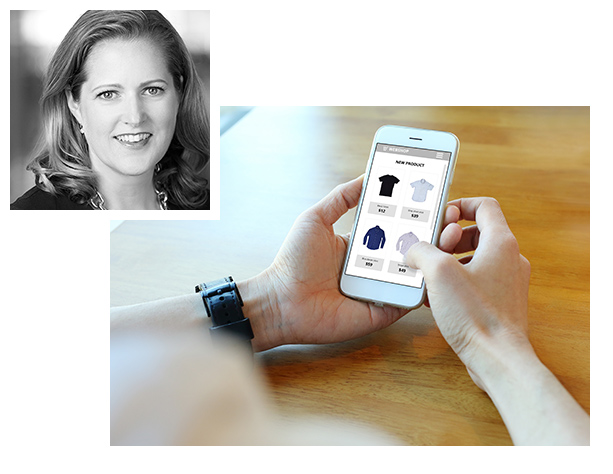
Another important factor is how fast mobile technologies are changing. Buying online using smartphones and tablets will soon be the biggest single sales channel in many markets, so you can’t assume that building your e-commerce platform for laptop or desktop computers is good enough. Instead, your platform will need to adapt smoothly to whatever device the customer happens to be using.
Buying online using smartphones and tablets will soon be the biggest single sales channel in many markets
The shape of things to come?
According to a 2015 report from Morgan Stanley, “The first half of 2014 saw 26% of China’s online purchases being made through its 780 million active mobile devices. Of those, 58% were registered in lower-tier cities, where the users’ first experience of the internet was likely to be on a cellphone. Indeed, there has been a strong correlation between online shopping and smartphone penetration since 2011. Faster and cheaper 4G network connections should help accelerate mobile usage.”

Basic e-commerce platforms
E-commerce platforms fall into categories. These will be looked at in more detail later on, but in brief, they are as follows:
1. Simple marketplace
The most basic platforms are simple marketplace environments such as eBay. They are essentially online catalogues where a company’s products are lumped in with the products of many others.
2. Storefront platforms
Next are “storefront” platforms with varying capabilities. They simplify how you set up an online store by providing ready-made templates you can use to create the site. Some provide payment options and can handle international orders. Shopify is an example.
3. Custom platforms
If you need a sophisticated platform that is customized for your business, you can use a specialized software developer. This is usually needed if you are doing a large volume of business in a number of overseas markets.
Getting mobile
It is essential to invest in platforms that can effectively reach the company’s potential customers. Since more and more people use mobile devices for online shopping, the platform should work as efficiently with mobile apps as it does with desktop software. “User experience is important because the shift to mobile is already here,” says Brennan Loh, Shopify’s Director of Business Management. “More people are visiting Shopify sites from mobile devices than they are from desktops.”

Choosing payment methods
Regardless of the platform you choose, you need to provide a range of payment options. At a minimum, you should offer an electronic payment method plus a credit card option, both of which should be able to handle international transactions. This means that you will need an account with an electronic payment gateway (such as PayPal) and a merchant account with a credit card provider.
Many platforms offer payment options. This can be an ideal solution for smaller businesses since it simplifies the transaction process for both seller and buyer, and is easy to set up. The cost is usually based on a flat monthly fee, regardless of sales volume, plus a small fee for each sale. Make sure that the platform supports your preferred payment methods before making any commitments.
It’s critical that the payment methods be secure so that credit card data and bank information, on both sides of the sale, are never compromised. Use the platform’s fraud protection services if it is offered.
Ensuring fast, reliable logistics
Fast, dependable and inexpensive delivery will help build your brand with international customers.
- The e-commerce platform should clearly indicate how the customer’s order will be shipped, how much it will cost and how long delivery will take.
- Many companies use fulfilment services. These third-party logistics companies store and pack and ship a company’s product and provide tracking information. It may be possible to include the fulfilment service into the platform itself. Orders are then filled and shipped automatically.
- If you handle the shipping yourself, use a reliable shipper with expertise in international logistics.
Taking care of logistics
“You need to have your shipping processes set up from the beginning,” says Stairs. “Whether it’s Canada Post or couriers, understanding what it will cost to get your package to those markets is key to making sure your sales in those markets are profitable. Also, having a return policy for international customers is important—it’s the minimum you need if you’re going to succeed in retail e-commerce.”

Providing top-quality after-sales service
You will get much more repeat business if your buyers are pleased with your customer service. For example:
If your Canadian customers need after-market support, you can bet your international customers will need even more. Be prepared to provide this support and to handle language and cultural barriers.

If you can’t respond immediately to a question, use an automatic response email to tell them when they can expect an answer. All questions should be answered within 24 hours.

Provide clearly written and easily understood policies that cover returns, warranties and guarantees. Make them easy to find.

Ensure that your logistics are set up to handle international returns. Fulfilment services may be able to handle this for you.
Talking to customers
“For us,” says Josh Fine of Manitobah Mukluks, “e-commerce is more than half our business, which is unique for a footwear company. It means we can communicate directly with our customers, and that allows us to learn and grow. It means we can speak with thousands of consumers, where before we had a lot of layers between them and us. And I think that many Canadian companies have the same potential.”

Other issues to consider
Selling overseas is more complex than selling domestically, whether you’re doing it using e-commerce or not. You will need to deal with multiple languages and currencies, as well as taxes, duties, international shipping fees and so on.
You also need to be sure you can sell your goods into some markets—does the Canadian government impose restrictions on exporting your product, or does the country you’re selling to have import controls? Your platform provider may be able to manage some or all of these issues for you, or you can look to an international import/export service provider.
In general, experts advise you to start small. Do your research and then pick one or two markets where it will be relatively easy to do business, such as the United States or Great Britain. Even then, expect to spend some time building your brand before sales begin to take off.
Canada Tariff Finder
The Canada Tariff Finder is a free tool that allows Canadian exporters to check the tariffs applicable to a specific good in a foreign market.