Canada’s defence exports: Where global military spending creates opportunity
Author details
William Thomas
Senior Associate | Country & Sector Intelligence
Malcolm Fisher
Associate Quantitative Analyst, Economic and Political Intelligence Centre
In this article:
Global defence spending is entering a new phase. Lean military budgets following the Cold War have given way to structurally higher spending as Russia’s war in Ukraine, U.S.-China rivalry, conflict in the Middle East and questions about longstanding defence commitments push countries toward greater self-reliance.
For Canadian exporters, this marks an important shift. Rising procurement across allied markets is creating a larger, more stable pipeline for defence sector firms. But Canada’s export opportunity will depend on how effectively domestic firms can scale beyond Canadian procurement and deepen their role in allied supply chains.
According to Gordon Scharf, Export Development Canada’s (EDC) national lead for the defence ecosystem, Canadian defence and security companies are operating in a very different global environment than they were just a few years ago.
“Allied countries are rebuilding readiness, strengthening supply chains and looking for trusted partners. Canada has strong capabilities in areas such as advanced inputs, land systems, aerospace and mission technologies. The opportunity now is to help more firms scale those capabilities internationally and become deeper partners in allied procurement networks,” Scharf says.
Key takeaways
- Defence spending is structurally rising, with geopolitical tensions driving sustained procurement growth
- Canada’s industry is expanding but remains domestically driven, with strengths in advanced inputs, subsystems and maintenance, repair, and overhaul (MRO)—especially in air and land
- Export upside exists, but depends on diversifying beyond the U.S. and integrating into allied supply chains
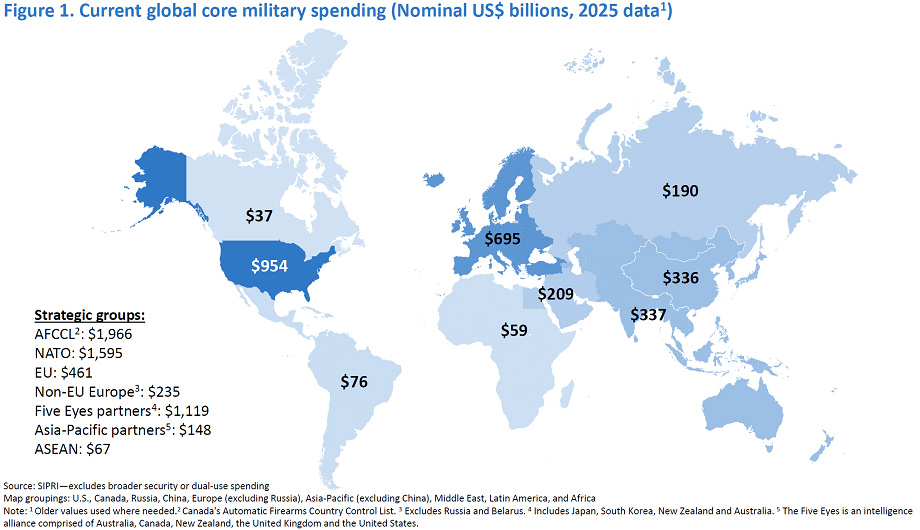
In 2025, members of the North Atlantic Treaty Organization (NATO) spent roughly US$1.6 trillion on core military capabilities, with about US$954 billion spent by the United States (see Figure 1). Canada and European allies accounted for about US$627 billion—a sharp increase from prior years that reflects elevated threat perceptions and pressure to rebuild readiness and replenish stockpiles.
The United States remains the world’s dominant defence spender, but Europe’s spending has accelerated since Russia’s full-scale invasion of Ukraine began in 2022. Over this period, U.S. core spending has risen by roughly 10%, compared with 70% across the rest of NATO.
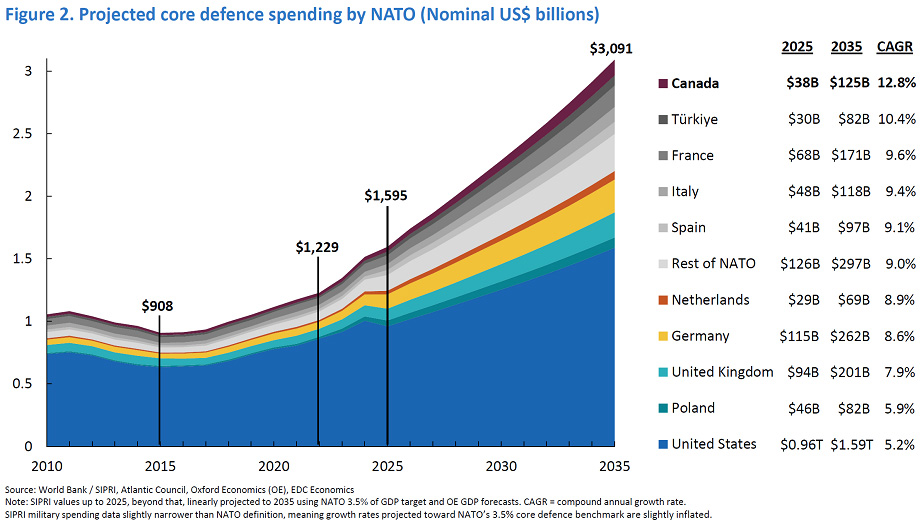
This shift reflects a renewed effort by NATO members to meet their defence spending targets of 2% of gross domestic product (GDP), which were set in 2014. In 2025, all NATO members met this target for the first time, with the exception of Iceland, which is exempt because it doesn’t maintain a standing army. That milestone was accompanied by a new commitment to spend 3.5% of GDP on core military spending by 2035. Asia-Pacific military spending is also rising, but at a more gradual pace, pointing to slower adjustments in defence outlays.
If NATO progresses toward core military spending of 3.5% by 2035, total outlays are expected to approach US$3 trillion, unadjusted for inflation (see Figure 2). Spending would also become more balanced geographically within the alliance, with the U.S. share declining as Canada and European allies expand their contributions. For companies in the defence and security ecosystem, this points to a larger and more stable procurement pipeline across munitions, platforms, inputs and technical services.
You should also check out
-
ArticleMarch 10, 2026
EDC’s evolving support for Canada’s defence and security sector
Helping Canadian companies seize new opportunities in a changing global security landscape.
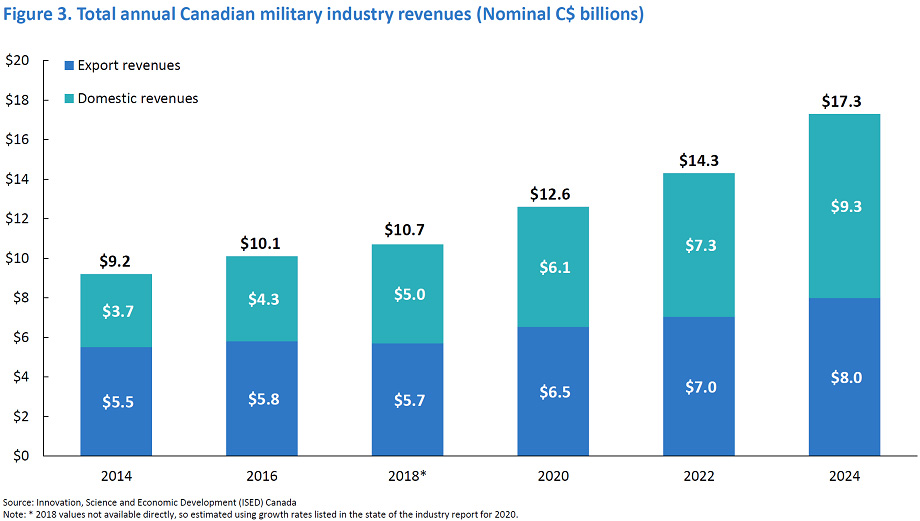
Against this backdrop, Canada’s defence industry is expanding. According to the latest available data from Innovation, Science and Economic Development Canada (ISED), the sector generated approximately $17.3 billion in revenue in 2024.
In this context, the defence sector refers broadly to firms involved in the production, maintenance and support of military equipment and services. Since these activities cut across multiple industries, ISED’s estimates of Canada’s defence sector rely on a combination of data sources, including mandatory surveys, government data and industry collaboration, rather than a singular industry classification.
As shown in Figure 3, Canada’s domestic defence revenues have grown nearly twice as fast as exports in recent years. This suggests that the industry’s expansion is being primarily driven by Canadian government procurement, rather than faster growth in international sales.
More broadly, this pattern reflects the longstanding role of public spending in shaping Canada’s industrial base. This pattern of domestic strengthening is expected to continue over the short term under Canada’s Defence Industrial Strategy before firms can contribute more significantly to export growth. The strategy is built on a build-partner-buy framework, which aims to develop export-oriented capabilities by first strengthening the domestic industrial base. Under this approach, Canada is targeting roughly 70% of defence spending to flow to domestic firms, up from about 50% today.
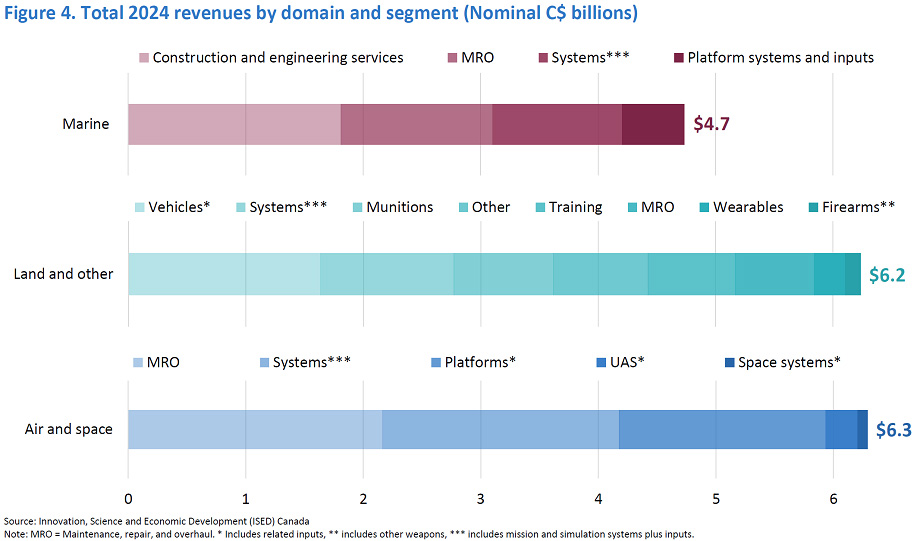
A closer look at Canada’s defence sector (see Figure 4) shows revenues are concentrated in areas of established capability that are already integrated into allied supply chains.
Canada’s industrial strength is most evident in:
- Land vehicles, where Canadian firms have an established role in allied defence markets
- Advanced subsystems, including sensors, electronics and software
- Technical services such as MRO
- Mission and simulation systems across air, land and marine domains
Overall, Canada’s defence model is centred less on platform leadership and more on sustainment, subsystems, engineering-intensive services and selected niche platforms.
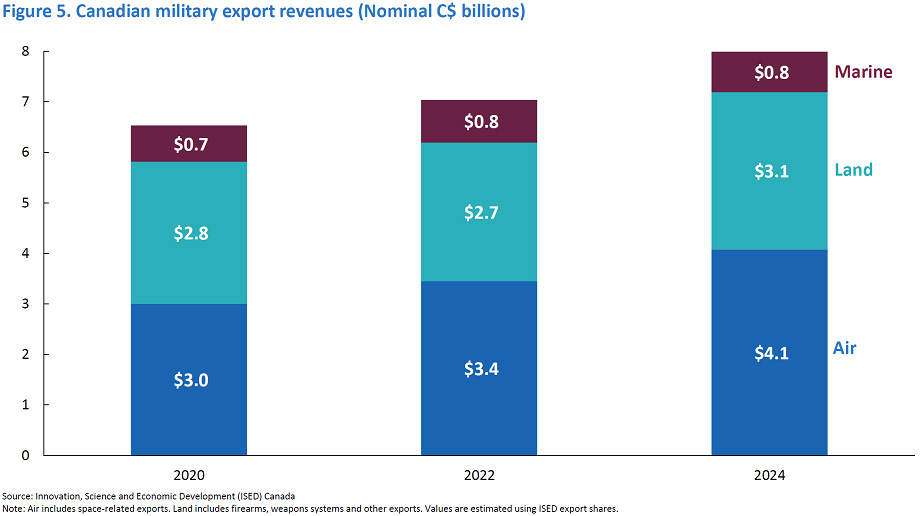
Aerospace is Canada’s primary defence export driver (see Figure 5), reflecting its globally competitive and highly integrated role in advanced inputs such as engines and components, as highlighted in EDC’s recent aerospace article.
According to Peter Johnston, director of EDC’s aerospace team, “Canada’s aerospace sector gives our defence industry a strong export foundation. From engines and components to simulators and MRO, Canadian firms are already trusted suppliers in global aerospace supply chains. As allied countries increase defence spending, those capabilities position Canadian companies to compete for a growing range of opportunities in international markets.”
Comparing Figures 4 and 5 shows that marine activities account for a meaningful share of Canada’s domestic defence industry, supported by notable federal investment in shipbuilding over the past decade through the National Shipbuilding Strategy (NSS). However, this activity hasn’t yet translated into significant export strength. That reflects the NSS’s primary focus on rebuilding domestic capacity and supporting long-term fleet renewal and maintenance after a significant period of decline in Canada’s shipbuilding sector.
That said, export potential could increase as these capabilities mature. Recent international partnerships such as the ICE Pact—a trilateral agreement between Canada, the United States and Finland—focused on icebreaker development, highlight growing marine opportunities for Canadian firms, particularly in design, engineering and specialized vessels. This opportunity is reflected in the 2026 agreement for Canada’s Seaspan Shipyard to export icebreaker designs and associated supply chain packages to support the development of up to six U.S. Coast Guard Arctic security vessels.
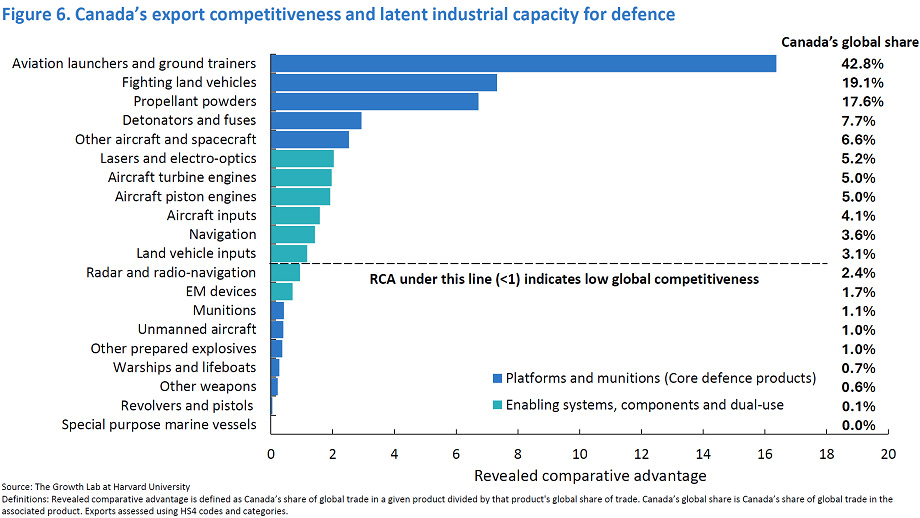
Looking at Canada’s revealed comparative advantage (RCA), Figure 6 shows which Canadian defence exports are currently more competitive globally. Canada performs strongly in aerospace and select defence-related areas, including fighting vehicles, propellants, detonators and subsystems such as navigation equipment, lasers and electro-optics. This reinforces that Canada’s strongest export opportunities lie in advanced inputs—especially for land and air applications—and that existing capabilities have the potential to capture growing global defence markets.
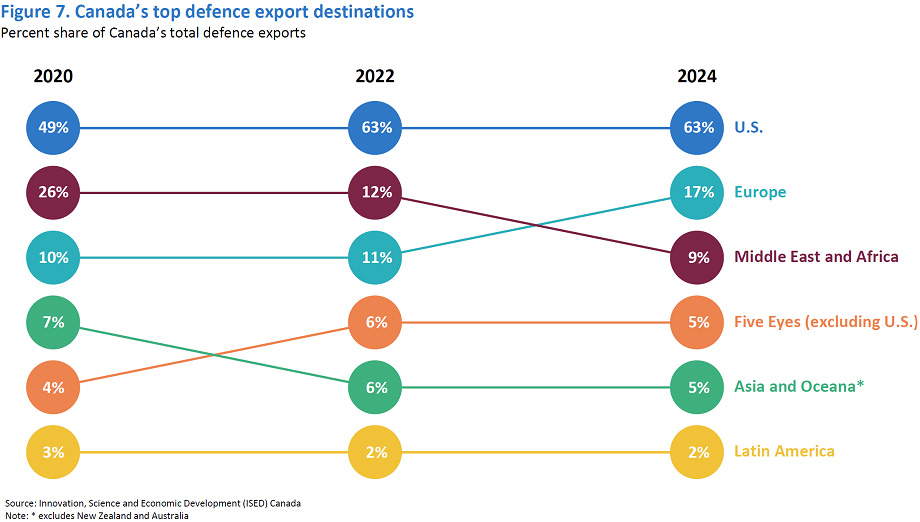
As with Canada’s broader export profile, the United States remains the sector’s dominant market, accounting for roughly half of defence exports, ranging from about 49% in 2020 to approximately 63% in 2024 (see Figure 7). This concentration partly reflects the high degree of integration between Canadian and U.S. industrial supply chains, particularly in sectors such as aerospace and manufacturing, where cross-border production is common.
Europe has emerged as an important source of diversification, with its share rising to 17% in 2024. That share is expected to grow alongside increased defence spending across the region. Beyond these two markets, export shares decline more sharply. Regions such as the Middle East and Africa, along with Australia, the United Kingdom and New Zealand—the other members of the Five Eyes intelligence-sharing partnership—represent smaller but notable opportunities relative to their size. The elevated level of exports to the Middle East in 2020 reflects a one-off contract for light armoured vehicles, rather than a sustained export trend.
The global competitive landscape varies significantly by segment. Platform-heavy, systems-integrated markets—such as fighting vehicles, munitions, propellants and aircraft—are dominated by a small group of established producers in the U.S. and the European Union. These firms are supported by deep domestic procurement relationships and highly integrated supply chains, creating substantial barriers to entry.
By contrast, inputs to final defence platforms—such as aerospace parts, specialized components and sensing or electro-optical technologies—are more accessible for new entrants. Competitiveness in the input landscape depends less on prime contractor status and more on cost, reliability and integration into allied supply chains. This aligns with most of Canada’s existing strengths, aside from armoured vehicle production, suggesting export growth is more likely to come from components and subsystems than complete platforms.
An important enabling factor is Canada’s position in critical minerals. Canada produces 10 of NATO’s 12 defence critical raw materials and has a reputation as a reliable supplier of inputs for allies. This is reflected in established production of inputs, including titanium at about 12.7% of global output, aluminum at about 4.5% and copper at about 1.5%. These materials support competitiveness in aircraft components, vehicle inputs and defence manufacturing.
Beyond current production, Canada also holds significant reserves of defence-critical minerals, including the tungsten-rich Mactung deposit, antimony, at about 3.9% of global endowment, and rare earth elements that Canada doesn’t yet produce at scale. Expanding extraction and processing in these areas would strengthen supply security, reduce input costs and enhance the competitiveness of Canadian defence manufacturing.
The bottom line for Canadian defence exporters
Canada enters the current global defence cycle from a position of real but uneven strength. The domestic industry is expanding, supported by rising procurement and deliberate policy, with clear niches in MRO, mission systems, simulation, land vehicles and aerospace inputs.
However, exports remain concentrated by market and capability. If allied spending continues to rise through 2035, Canada will have an opportunity to convert domestic momentum into broader export growth. Whether that opportunity is realized will depend on the ability of Canadian firms to scale beyond domestic programs and deepen their integration into allied procurement ecosystems.
Navigating global defence and security markets requires more than technical expertise. Companies also need a clear understanding of procurement cycles, buyer requirements, geopolitical risk and the financing needed to scale.
EDC works with Canadian defence and security companies to assess opportunities, manage risk and build connections in global markets. In 2025 alone, we provided $692 million in financing and insurance-related support to 28 Canadian defence and security companies.
We support Canadian companies across the defence ecosystem through:
- Market intelligence and analysis to give exporters a clearer understanding of buyer requirements, risk factors and opportunities across trusted supply chains
- Financing and working capital support to enable companies to expand production, invest in growth and compete for larger international contracts
- Risk-management solutions, including trade credit insurance, to help protect against non-payment and support international business with confidence
- Business Connections and advisory services to strengthen relationships with international buyers, partners and financial institutions
Contact your relationship manager or submit a product inquiry to see how EDC can help your business compete in the defence and security sector.
Acknowledgements
We’d like to thank the experts at ISED’s Industrial and Technological Benefits Branch, who generously shared their time and insights. Their contributions helped strengthen the analysis throughout this report.