How wildfires disrupt Canada’s economy: Trade and infrastructure impacts
Author Details
Karicia Quiroz
Economist | Country & Sector Intelligence
William Thomas
Senior Associate | Country & Sector Intelligence
In this article:
Wildfires have become an increasingly disruptive force across Canada’s landscape and economy. While the total number of fires hasn’t necessarily increased over time, research shows they’re becoming larger, more destructive and more costly.
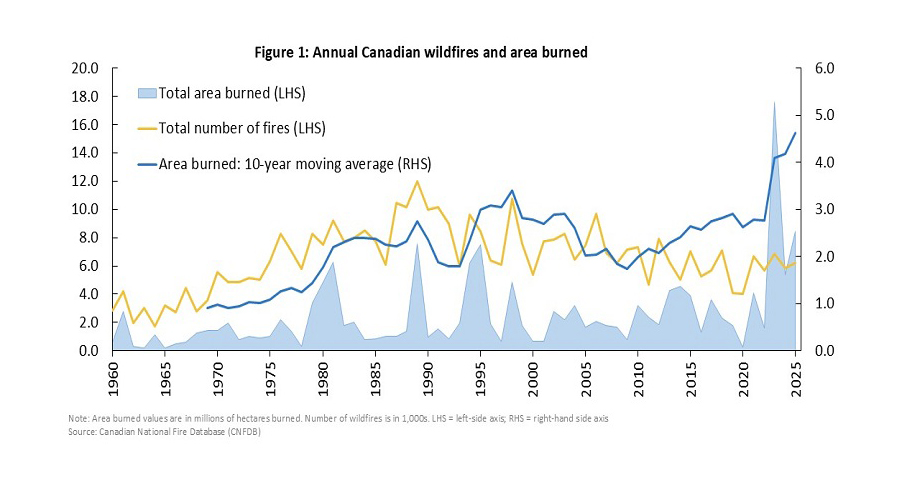
Canada has experienced several of its most severe wildfire seasons on record in recent years. The record-breaking 2023 season burned 17.6 million hectares, while 2025 became the second-largest season on record at 8.4 million hectares.
The 2026 wildfire season is continuing that trend. By mid-August, more than 4,700 fires had burned more than 4.1 million hectares across the country, with the Northwest Territories, Quebec, Ontario and British Columbia accounting for more than 80% of the area affected. B.C. has faced particularly intense pressure, at times reaching Canada’s highest wildfire-alert level as crews battled extreme fire activity and stretched resources. Recent wildfire seasons have forced large-scale evacuations, disrupted tourism, closed transportation routes and strained firefighting resources across several regions of the country.
The impacts of wildfires extend far beyond the destruction of homes and businesses. They can significantly disrupt livelihoods, harm public health, interrupt production, damage critical infrastructure and reduce economic activity in affected regions. For Canadian exporters, the impact is twofold: Directly, through disruptions to production and exports in affected regions, and indirectly, through interruptions to the transportation and infrastructure networks that connect Canadian businesses to global markets.
Economic impact of wildfires
While the frequency of Canadian wildfires has declined since 1989 (see Figure 1), their severity has increased dramatically. Rising temperatures and prolonged dry seasons—driven by climate change—continue to worsen wildfire conditions.
In recent years, the area burned by wildfires in Canada has reached unprecedented levels. The 2023 wildfire season scorched approximately 17.6 million hectares, more than double the previous record set in 1989 (see Figure 1). The 2025 season followed as Canada’s second-worst on record, with 8.4 million hectares burned nationwide.
Although the 2026 season is still underway, more than 4.1 million hectares had already burned by mid-August, exceeding the 10-year average for the same point in the season.
You should also check out
Commodity prices can impact exporting, global trade and your business, so it’s important to be prepared for the challenges ahead.
To better understand the true cost of wildfires, it’s important to look at their localized impacts and the direct financial toll they impose on homes, businesses and communities.
The financial burden of wildfires and other severe weather events is also climbing. According to the Insurance Bureau of Canada, insured losses from catastrophic weather events and wildfires totalled $37 billion between 2016 and 2025, far exceeding inflation-adjusted losses in the previous decade.
The growing cost of wildfire damage reflects a broader trend. As wildfire seasons become longer and more severe, businesses, communities and governments face higher recovery costs and greater exposure to economic disruption.
Several recent wildfire disasters illustrate the scale of those costs:
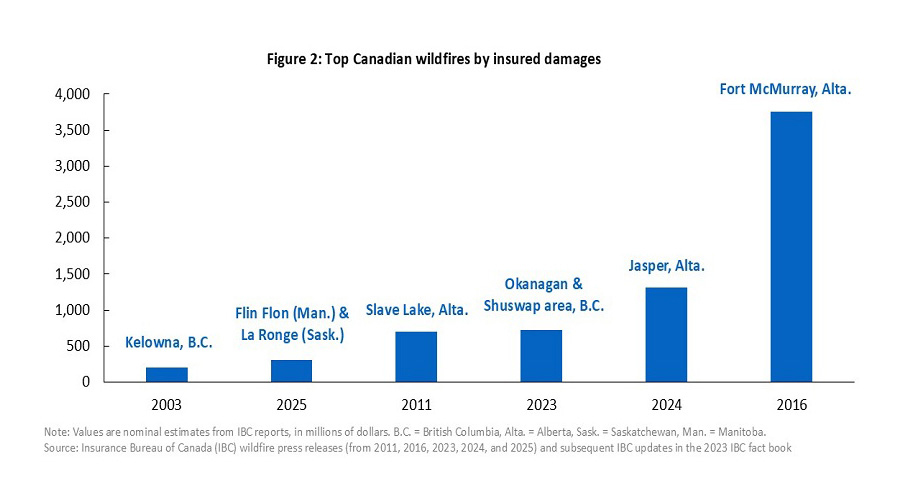
- The 2016 Fort McMurray, Alta., wildfire, which holds the record for insured damages at nearly $3.8 billion.
- The 2024 Jasper, Alta., wildfire and the 2023 Okanagan and Shuswap, B.C., wildfires, which rank second ($1.3 billion) and third ($720 million) in insured damages (see Figure 2).
- Over the past decade, three of the costliest wildfires on record have occurred. With the increasing severity (total area burned) of wildfires in recent years, high-cost wildfire events may become more common.
Wildfires can negatively impact the Canadian economy in multiple ways beyond the immediate destruction of property. One of the most affected sectors is forestry, as wildfires can reduce timber supply, disrupt processing operations, and contribute to price volatility. Poor air quality can also deter tourism, reduce productivity and affect public health well beyond the immediate fire zone.
Thank you for reaching out to EDC.
Please watch your inbox for our email.
Loading
Thank you for applying for coverage under your PSG Margin.
How wildfires disrupt Canadian exports and trade infrastructure
In addition to the direct impact on the forestry supply chain, whose processed products (e.g., wood products, pulp, paper and paperboard) are largely export-oriented, wildfires can affect Canadian trade through at least two other channels:
Direct disruption to production and exports in affected regions
- 2016 Fort McMurray wildfire: According to Canada Energy Regulator data, oil sands production losses peaked at up to one million barrels per day (MMb/d), equivalent to nearly $45.2 million in lost revenues per day (based on the May 2016 Western Canada Select (WCS) crude oil price). These losses led to a 14% drop in Alberta’s crude oil export volumes—from an average of 2.9 MMb/d in the first quarter of 2016 to 2.49 MMb/d in June. Fortunately, with limited damage to oil sands facilities, production and exports rebounded quickly, reaching 2.84 MMb/d by August 2016.
- 2024 Jasper wildfire: Jasper, a tourism-dependent community, has nearly 49% of its workforce employed in tourism. According to Prairies Economic Development Canada, in 2023, prior to the wildfire, Jasper National Park generated $446 million in visitor spending—80% of which came from international visitors (considered exports). The 2024 wildfire caused a sharp decline in visitation to Jasper National Park, dropping from 2.48 million visitors in 2023 to 1.13 million in 2024—a 54% year-over-year (YOY) decrease, according to Parks Canada. Although visitor volumes rebounded to 2.13 million in 2025, they remained below pre-wildfire levels. The 2024 wildfire initially destroyed 358 homes and businesses, and although rebuilding has advanced substantially, recovery remains ongoing as housing shortages and reconstruction challenges continue to affect the community.
Wildfire impacts on rail, freight and export infrastructure
- Freight volume declines: Despite the severity of the 2016 Fort McMurray wildfire, total rail freight volumes of goods transported from Alberta/Northwest Territories were 58.3 million tonnes (MT) in 2016—a modest 1.5% YOY decline, according to Statistics Canada’s rail industry data. However, freight volumes to the U.S. and Mexico fell more sharply, down 3.2% YOY to 20 MT. Fuel oils and crude petroleum were key contributors to shipments destined for these export markets, with volumes dropping 17% YOY. In 2023, during the Okanagan and Shuswap wildfires, B.C.’s total freight volumes rose slightly (1% YOY to 60.7 MT), but its freight volumes to the U.S. and Mexico fell 16% YOY, driven by a 20% drop in lumber shipments.
- Rail and port disruptions from the 2024 Jasper wildfire: The Canadian National Railway Co. (CN Rail) temporarily suspended service in Jasper, delaying goods movement to B.C. export hubs. Smoke conditions also caused train slowdowns, delaying grain shipments bound for the Port of Vancouver for export.
While the full extent of wildfire-related disruptions to export volumes through trade-enabling infrastructure remains unclear, the issue warrants greater attention given the importance of transportation networks to Canada’s merchandise exports.
Major wildfire events have highlighted how vulnerable key transportation corridors can be when fires threaten highways, rail lines and surrounding communities.
In 2025, road (38.6%) and rail (10.9%) accounted for a combined 49.5% share of Canada’s merchandise exports, according to Statistics Canada trade data. Given the importance of these transportation networks, disruptions can affect the movement of goods to domestic and international markets.
Given the reliance on vulnerable infrastructure, EDC’s insights on supply chain optimization offer strategies to help exporters mitigate risks and build resilience in the face of such disruptions.
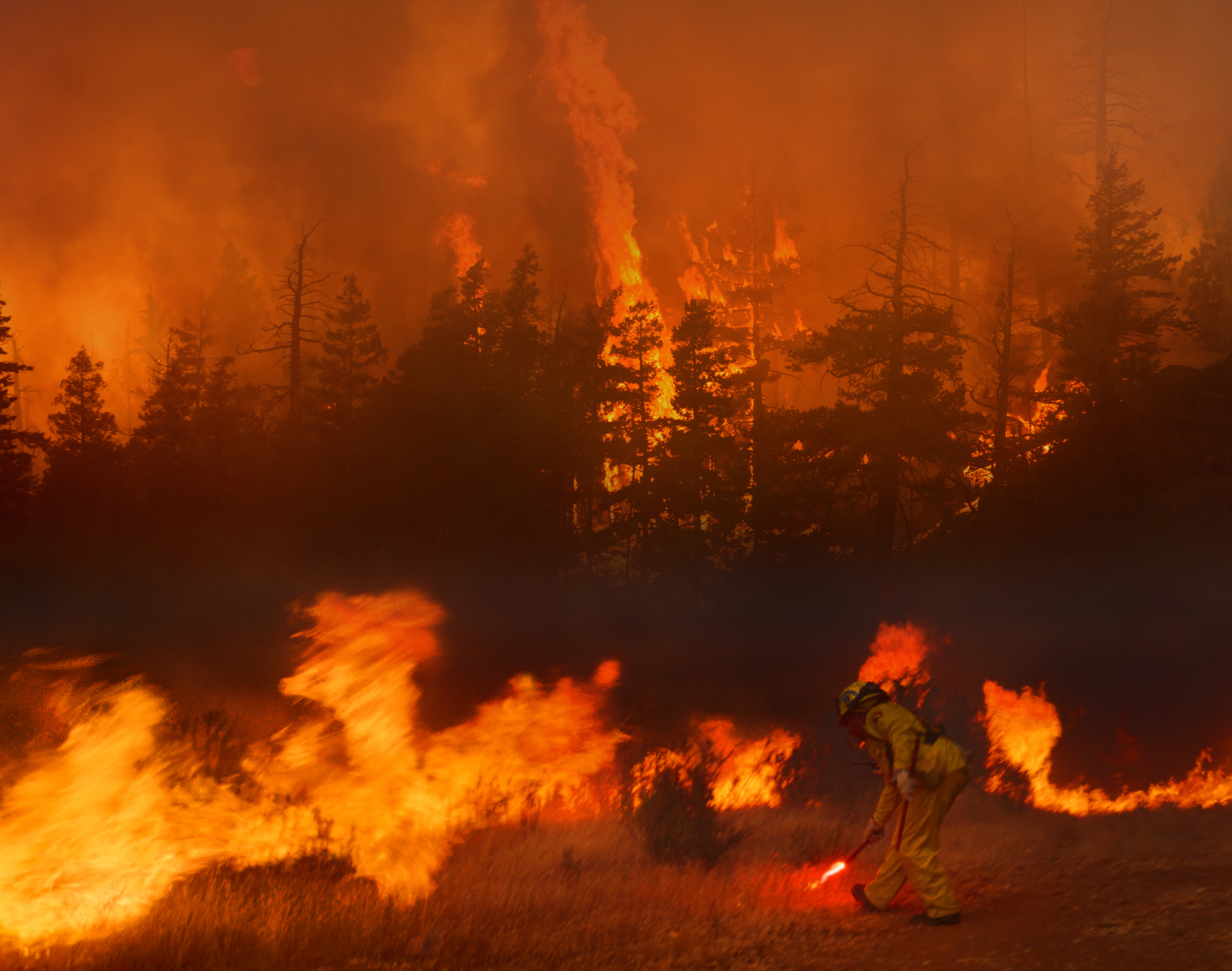
A firefighter in Cache Creek, B.C., set a backfire to combat a forest blaze.
Canada’s wildfire future: Economic risks and resilience strategies
Wildfires are intensifying, with their impacts spreading across broader regions, communities and industries in Canada. The economic costs vary widely depending on factors such as duration, location and the sectors affected.
These events are no longer merely isolated environmental emergencies. They’re an increasingly significant economic risk that can disrupt communities, supply chains, transportation networks and export activity across Canada. As seasons become longer and more severe, both the direct and indirect costs of wildfires are expected to grow.
Canada’s resource-based economy places a substantial portion of business activity in remote regions that are particularly vulnerable to wildfire risks. These areas also rely heavily on critical trade-enabling infrastructure—such as Canada’s vast rail and highway corridors—which can be challenging to replace or reroute when disruptions occur.
To safeguard Canadian productivity and reduce economic losses, sustained investment in wildfire mitigation and infrastructure resilience is essential. Governments, communities and businesses all have a role to play in strengthening our collective response to these escalating threats.
Explore EDC’s support for Canadian exporters facing trade uncertainty and market disruptions. To contact an EDC export advisor, visit our Export Help Hub and sign up for MyEDC account.
Acknowledgements
We’d like to thank the external experts who contributed valuable insights to this piece in 2025, including key contacts within Statistics Canada’s Economic Analysis Division, who have worked extensively on GDP-at-risk estimates in wildfire-affected areas; Ryan Ness, director of Adaptation at the Canadian Climate Institute; and Thibaut Duprey, senior director at the Bank of Canada, whose research focuses on the economic impacts of natural disasters in Canada.
You should also check out
With timely insights and financial analysis from our experts, Export Development Canada can help you enter new markets, grow your global business, and reduce risks with confidence.