
How to prepare your food and beverage business for global private label deals
Author details
Susan Redding
Senior international trade writer
In this article:
- The benefits of private label deals for Canadian agri-food manufacturers
- What do private label agreements typically involve?
- Key steps to get your business ready for an international private label deal
- Landing the deal: Tips for approaching food and beverage retailers
- What are the keys to long-term success in private label manufacturing?
- Looking ahead: Managing risk while growing through private label manufacturing
- Leverage EDC to grow your global footprint
This two-part series summarizes the Export Development Canada agri-food team’s top insights on private label opportunities for Canadian food and beverage manufacturers. Part 1 provides an overview of the private label landscape in key global markets and explains why we think it’s such a promising avenue for expanding Canadian exports. Part 2 outlines practical steps your company can take to land private label contracts with major international buyers.
Demand for private label goods is growing in key global markets. With major global retailers on the hunt for new private label partners, it’s a great opportunity for Canadian food and beverage manufacturers to secure new deals and diversify internationally.
Understanding their needs and getting your business ready to meet them is critical for success.
“Large European and international retailers prioritize high-volume, compliance-ready suppliers rather than early-stage innovation alone,” says Ashley Kanary, EDC’s agri-food lead. “These retailers are seeking strategic partners for their private label programs—not short-term suppliers.”
When you’re ready, private label contracts can be an effective way to grow your business, both at home and in international markets. Here are some practical steps you can take to prepare your agri-food company for a private label deal, make inroads with global buyers, win contracts, grow the relationship and expand into new markets.
Adding private label contracts to your production mix is an effective way to make your business stronger while speeding your entry into new markets. Potential benefits include:
- Stable demand and cash flow: Private label contracts give you steady and predictable revenue streams. You simply make and ship the product, while the retailer takes care of marketing, sales and everything else. The consistent orders make financial planning easier and can improve your profitability.
- Increased efficiency: The steady demand from a private label deal can help you scale your operations, optimize your production capacity, improve the overhead absorption rate of your facility and organically boost profitability by reducing your cost per unit.
“When you make more, your facility can run longer, more efficient production cycles and operate at higher capacity. That improves throughput and overall plant efficiency,” explains Kanary. “You’re also spreading your fixed costs—like rent, electricity and other plant expenses—across a greater volume of products, which lowers the cost attributed to each unit.” he says, adding, “Your branded products also get cheaper to make because you’re making more goods in your plant.”
- Reduced marketing costs: Building brand recognition in a new market is costly and challenging. With private label, your retail partner handles branding and promotion, saving you money and making it easier to reach consumers.
- Simplified market access: Private label deals with international retailers can be a one-two punch for market entry. First, use a private label contract to get your products into the market. Once you’ve developed the relationship and learned more about the market, you can approach your retail partner about selling your branded goods in their stores.
- De-risking innovation: It’s expensive and risky to launch new products, especially under your own brand. You can reduce the risk by collaborating with your retail partner to introduce innovations under their private label instead, using their brand as a test market.
“Not every new product is a winner. But if you try out a wild idea—like a dill pickle pizza—under a big store’s private label, you let them handle the risk and marketing,” Kanary says. “If people love it, you can later launch your own brand of dill pickle pizza, knowing it’ll sell. It’s a smart way to test new ideas without putting all your money on the line.”
Private label agreements typically require the manufacturer to produce goods according to the retail client’s specifications, including recipe, packaging and branding, so the product fits the retailer’s unique identity. The manufacturer may be responsible for logistics and distribution, or the retailer might handle distribution directly. Private label deals involve tighter collaboration than standard white label or contract manufacturing. The result is an exclusive product that helps the retailer bring in customers and build brand loyalty.
- Measure your production capacity: It may be tempting to chase a huge deal, but “you don’t want to be like the dog that caught the car by taking on a contract that’s just too big for you,” says Kanary. Find deals that you can manage within your current capacity and build from there.
- Research regulations: Certifications, food safety standards, traceability, labelling requirements and banned ingredients vary by market. Getting them right is essential. “Market access can stall quickly if companies aren’t ready on labelling, product classification, certification, documentation, or retailer-specific requirements,” Kanary says. Work with your retail partner, or a resource like EDC’s International Business Advisory service, Export Help Hub, the Canadian Food Inspection Agency (CFIA) or Agriculture and Agri-Food Canada, to understand exactly what’s required, so you can avoid costly mistakes.
- Check your financial readiness: Understand your margins, pricing structures and negotiation levers before you offer a price.
- Assess supply chain reliability: International contracts will stretch your supply chain. Make sure you can secure the raw materials and logistics needed to optimize your supply chain and avoid disruptions when manufacturing and shipping over longer distances.
- Scale up for success: Get ready to seize bigger opportunities. Large buyers remain volume-driven, and some opportunities may not progress if you can’t meet their pricing, volume or continuity expectations. EDC can support your investments in automation and artificial intelligence (AI) adoption to increase your factory’s capacity and productivity, so you can win more contracts while improving your margins.
You should also check out
Grow your business while reducing costs with practical, low-risk digital tools, automation and AI solutions.
Securing a successful international private label deal requires careful preparation. Here are a few ways you can stand out from the competition and secure a private label contract:
- Research retailers: Your goal should be to identify chains aligned with your product category that can buy the minimum volume you need to efficiently (and profitably) ship farther away. “You don’t want to make a deal with a small distributor that wants to ship half a pallet of your product overseas. You want big retailers that can efficiently bring a large order around the world at a cost that’s affordable for the consumer,” says Tracy Shwetz, EDC’s global trade director for agri-food.
- Build a compelling pitch: Your presentations to retailers must showcase your product quality, reliability and scalability. It’s also important to consider the business style in the retailer’s market. Is it a relationship-driven market, where you need to make time to get to know your partner before talking business? Is it a business-first place where you should you get to the point? Knowing what to expect and understanding business etiquette in the market can make your initial meetings go more smoothly.
- Target niche categories: Plant-based, organic and functional foods are in high demand globally. Canada’s well-known expertise in these categories is a competitive advantage.
- Highlight differentiation: Emphasize the things that make you stand out, like unique ingredients, sustainability practices, or local sourcing.
- Lock in your pricing strategy: Do your market research to find a price range that balances competitiveness with profitability.
- Know when to use brokers or consultants: If you’re unfamiliar with the retailer’s market, or need to break in with a major chain, working with an external expert may be the right move.
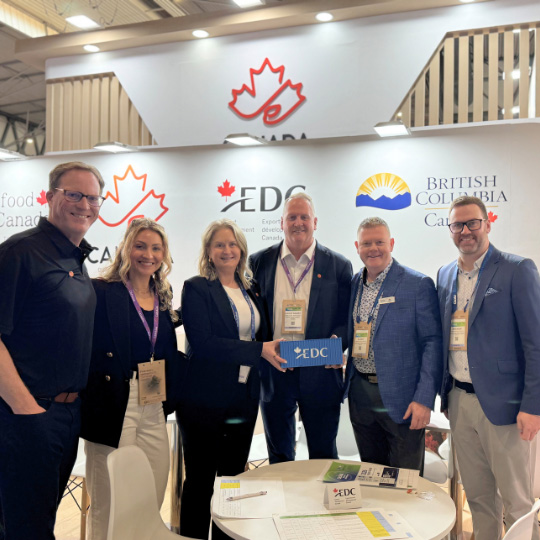
- Go to trade shows: Annual events like PLMA (Private Label Manufacturers Association) in Amsterdam and Chicago connect suppliers with global retailers. EDC also hosts matchmaking events at certain trade shows. “EDC will partner with you at these shows to facilitate warm introductions to global buyers to accelerate your private label discussions,” Shwetz says.
You can find the EDC team under the Canada Pavilion at these flagship international trade shows:
| Date | Event | Location |
| June 9 to 12, 2026 | Seoul Food & Hotel | Seoul, South Korea |
| Oct.17 to 21, 2026 | Salon International de l'Alimentation (SIAL) Paris | Paris, France |
| Oct. 28 to 30, 2026 | China Fisheries & Seafood Expo | Qingdao, China |
| March 15 to 19, 2027 | Gulfood | Dubai, United Arab Emirates |
| March 9 to 12, 2027 | FoodEx Japan | Tokyo, Japan |
| April 20 to 23, 2027 | Food & Hospitality Asia | Singapore |
| April 20 to 22, 2027 | Seafood Expo Global | Barcelona, Spain |
The real benefits of private label manufacturing emerge once you’ve built sustainable, long-term relationships with your buyers. You’ll need to know exactly which performance metrics your retailer partner uses to evaluate suppliers, Kanary says, but he offers these guidelines to help you understand their typical expectations:
- 99% fill rate: Consistent product quality and on-time delivery are the foundations of a strong private label partnership. “Maintaining a fill rate of 99% is essential. Nothing makes people run away from a private label contract faster than the vendor shorting them on a delivery,” he says. “You're making their brand, so it hurts their reputation when the product isn’t on the shelf because your production was down. Once you fail to deliver, you stop being a valued partner and become a liability, jeopardizing the entire relationship.”
- Stable pricing: “Build some contingency plans into your pricing because you can’t pass along the cost every time a supplier hands you a 1% price increase on your raw materials.”
- ESG compliance: “Every major retailer in the world has a posted ESG (environmental, social and governance) policy for suppliers to follow. Demonstrating that you understand and support their standards will help to keep your partnership strong.”
- Continuous innovation: Proactively offering new products and ideas for your partner’s private label program deepens the relationship and enhances your role. “If you have that reputation as an innovator, they’re going to come to you whenever they have a question about the category. Now, you’re not just the supplier, you’re a valued asset and a resource that they count on,” says Kanary.
As you solidify your reputation as a reliable and innovative private label partner, it’s important to plan for sustainable growth and resilience. With the right strategies in place, you can expand to new markets, while ensuring that your business remains strong.
Minimize retailer dependency
“Don’t put all your eggs in one basket,” says Shwetz. “It may seem great to have a huge contract with a major retailer, but you don’t want to end up in a position where losing one contract puts your whole company at risk. Minimizing retailer dependency means having a balanced portfolio of companies that you supply, with each representing a manageable percentage of your business. That sets you up to build over time and scale up at reasonable pace.”
Be smart about market diversification
Rather than taking a shotgun approach that targets every retailer or every market at once, plan your expansion carefully. Depending on your business, it may make sense to pursue more deals within one market before expanding to neighbouring countries or other regions. Whatever path you choose, avoid spreading your resources too thin.
EDC has relationships with 30 global retailers, including many of the top companies for private label. We help established Canadian agri-food exporters gain targeted access to these buyers by facilitating credible, demand-driven introductions—improving the quality of access—not just the volume.
Partner with us at your next trade show to connect with more global opportunities and accelerate market entry with a private label deal.
EDC offers a broad range of additional solutions for Canadian exporters, including:
- Direct lending to help you scale up your production capacity and efficiency to meet new demand in global markets
- Trade credit insurance to protect your business against non‑payment and offer competitive terms to trusted foreign buyers
- Working capital guarantees to free up cash flow, access additional financing and increase borrowing capacity
- Market intelligence and international business advisory support to help you understand requirements and consumer preferences in your target market
- The EDC Business Connections Program introduces qualified Canadian agri-food businesses to credible global businesses looking for suppliers and partners, so you can access new opportunities.
Ready to take your food and beverage company global through private label deals? Contact EDC to learn how we can support your growth in international markets.
Frequently asked questions about international private label deals
These frequently asked questions (FAQ) highlight key considerations for Canadian food and beverage manufacturers preparing for international private label opportunities.
International retailers typically look for suppliers that can deliver consistent quality, reliable volumes and strong food safety practices. They may also expect packaging and labelling compliance, dependable service and the ability to support a longer-term supply relationship.
Start by reviewing food safety, traceability, labelling, licensing and import requirements in your target market. Clear documentation, strong preventive controls and early regulatory research can help you avoid delays, reduce compliance risk and show buyers that your business is prepared.
Your business may be ready if it can produce at a consistent scale, manage margins, handle longer lead times and maintain reliable supply. It’s also important to understand your operational limits before committing to a contract with a large international retailer.
Demand varies by market, but buyers may be especially interested in center of store products, dairy, frozen foods, protein, and prepared salads. Organic, functional, premium and sustainability-focused products are also appealing. In Europe, there may be demand for commodities, bakery, oats, granola, maple and other breakfast-oriented products, Canadian manufacturers may find additional opportunities in categories that align with consumer preferences, retailer strategy and their own production strengths.
Continue series
Part 1 of 2 in series