Rising bond yields: Why higher rates matter for Canadian exporters
Author details
Ross Prusakowski
Deputy chief economist & director, Country & Sector Intelligence
In this article:
The bond market may seem remote from the day-to-day concerns of Canadian exporters, but its influence is hard to escape. Rising bond yields can increase borrowing costs, weaken customer demand and intensify currency and market volatility.
The International Monetary Fund (IMF) has warned that resurgent inflation or fiscal concerns could trigger a sharp rise in sovereign bond yields with broad repercussions across financial markets. For businesses already managing high costs and uncertain trade conditions, the bond market is no longer background noise.
Stock markets may attract more attention, but bonds have a broader reach into the economy. The global fixed-income market is valued at roughly US$161 trillion, only slightly less than the roughly US$165 trillion global equity market.
To benefit directly from stocks, people generally need to own or trade the underlying asset. That excludes many people: even in Canada—which boasts one of the world’s higher rates of stock ownership—an estimated 49% of households owned stocks in 2025, either directly or indirectly through funds, pension plans or other holdings. Interest rates across the economy, from mortgages and student loans to credit cards and corporate borrowing, are generally set with reference to a benchmark bond rate or at a margin above it. When the price of a benchmark bond falls, its yield rises. That increase can ripple across the economy, pushing borrowing rates and financing costs higher.
You should also check out
Global growth continues despite energy shocks, trade pressures and higher borrowing costs. See EDC’s latest forecasts and what they mean for Canadian exporters.
At their core, bonds are tradable debt. When a government or company issues a bond, it borrows money from investors and promises to repay it, usually on a specified date. Unlike stocks, which generally exist indefinitely, bonds almost always have a maturity date, with terms ranging from overnight to a century.
The price buyers are willing to pay determines the bond’s yield, or the return they receive. Bond prices and yields move in opposite directions: When prices fall, yields rise. The price reflects factors such as the length of time until repayment, the borrower’s creditworthiness, any collateral or external guarantees and investors’ expectations for inflation and economic growth.
A company may have only a few classes of stock but dozens of bonds with different maturities. Together, those maturities form a yield curve. Shorter-term debt generally carries less uncertainty and therefore lower interest rates than longer-term debt. Investors also use these curves to price other, less liquid forms of debt.
Corporate bonds don’t usually serve as market benchmarks because companies can merge, fail or disappear. That role generally belongs to sovereign bonds issued by national governments, but even among these, some are more influential than others.
As the world’s largest and most liquid bond market, the U.S. market plays a crucial role in setting reference prices across the global economy. No single asset is more influential than U.S. Treasury securities. With nearly US$30 trillion in marketable Treasury debt outstanding—almost 20% of the global bond market—and treatment in many contexts as equivalent to cash, U.S. Treasuries are the pre-eminent instruments in the debt market.
For much of the past two decades, bonds lived up to their sedate reputation. After the 2008 global financial crisis, quantitative easing by the U.S. Federal Reserve and other major central banks injected cash into the financial system, lifting asset values and helping send the S&P 500 Index up more than 690% between 2009 and 2025.
During this era, inflation remained below target in most major economies. The breakthrough in shale technology helped lower energy prices, business investment slowed as “asset-light” technology companies expanded and advances in technology made bond trading easier and cheaper. These forces helped push bond yields down. In Europe, a debt crisis in peripheral eurozone markets also shifted demand toward the debt of countries viewed as safer, including Germany and France.
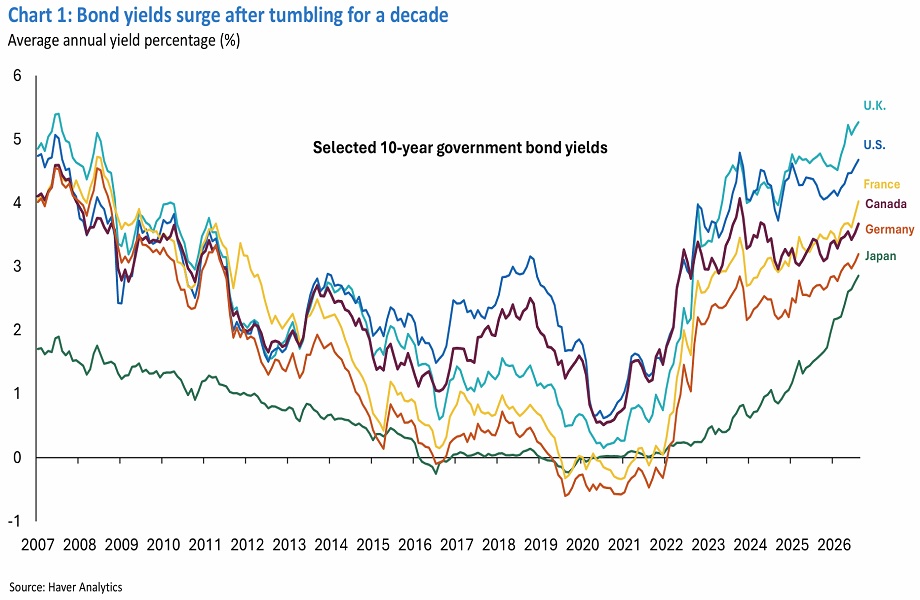
Benchmark 10-year government bond yields fell by nearly half between 2009 and 2019 (Chart 1). At the same time, labour force participation in major developed countries gradually recovered after the financial crisis, while the baby boomer retirement wave was forming but had not yet crested. This created a large pool of global capital seeking safe, stable returns, increasing demand for bonds and pushing yields lower.
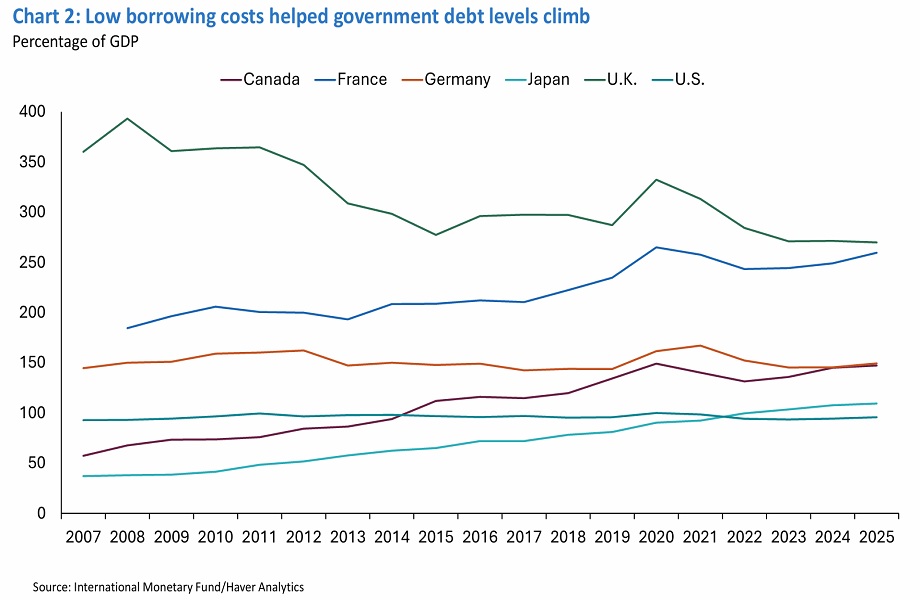
This period of ultra-low interest rates reduced concern about financing costs for governments, businesses and consumers. For governments, cheap borrowing weakened the incentive for fiscal discipline because higher spending or aggressive tax cuts could be financed with relatively low-cost debt (Chart 2).
Outside Germany, which has historically been sensitive to debt after experiencing hyperinflation in the 1920 and early 1930s, sovereign debt issuance surged. Debt climbed above 100% of gross domestic product (GDP) in many major economies. In 2020, governments borrowed heavily to support people and businesses during the pandemic. At the same time, investors sought the perceived safety of government bonds, pushing yields to historic lows and, in some cases, below zero. Investors were effectively paying governments to hold their debt.
Thank you for reaching out to EDC.
Please watch your inbox for our email.
Loading
Thank you for applying for coverage under your PSG Margin.
After nearly a decade of exceptionally low rates, many of the forces that pushed yields down have reversed.
Pandemic-related supply chain disruptions, Russia’s invasion of Ukraine in 2022, the effective closure of the Strait of Hormuz in early 2026 and heightened geopolitical competition have disrupted energy supplies and trade flows. Commodity prices have become more volatile, while governments are investing in defence and security. and companies are rebuilding inventories. This increased competition for resources is adding inflationary pressure to the global economy.
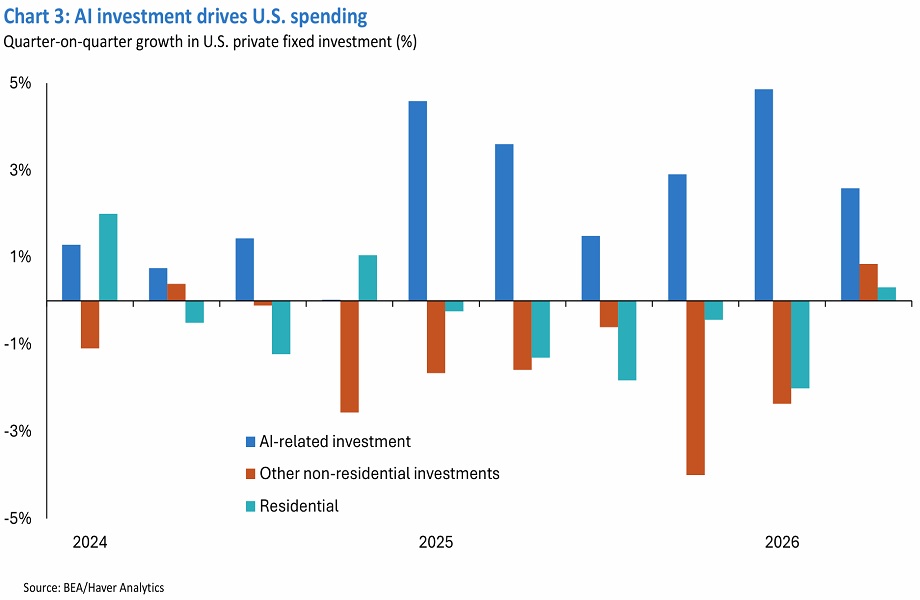
Commercial artificial intelligence (AI) has also transformed the investment outlook. As companies race to capture market share, leading technology businesses have shifted from “asset-light” models with billions of dollars in revenue and cash reserves to major investors in physical infrastructure (Chart 3).
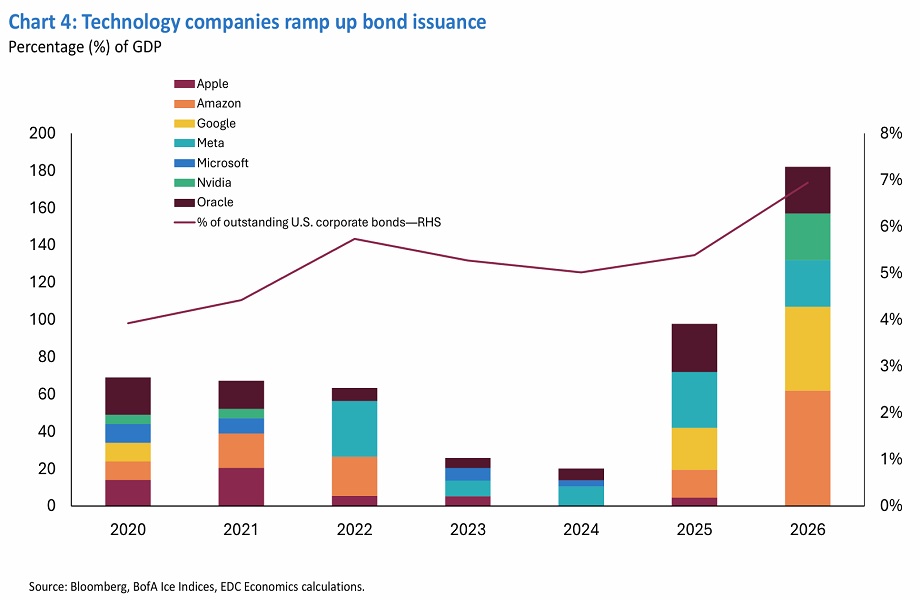
AI may appear to live in the cloud, but it depends on data centres, extensive cabling, advanced chips and enormous amounts of power. Building that infrastructure requires resources, manufacturing capacity, workers and capital. Hyperscaler technology companies that once parked cash in Treasuries are now selling some of those holdings and issuing their own debt. By 2026, these companies had issued more than US$150 billion in debt and accounted for 7% of the U.S. corporate bond market (Chart 4).
As corporate demand for financing increases, the pool of money available for bond investment is growing more slowly. Population growth has slowed in major developed economies and labour force participation rates have declined as the pandemic pushed people out of the workforce and the baby boomers retire. The retirement wave is expected to peak between 2024 and 2027 in the United States and between 2026 and 2030 in Canada. As retirees draw down on savings, less capital will flow into bonds and they will begin to sell assets for retirement income, further hitting yields.
The conflict in Iran has also disrupted capital flows from energy-rich Gulf countries. Rystad Energy estimates reconstruction costs of US$34 billion to US$58 billion. Saudi Arabia and Qatar have announced billions of dollars in bond issuance to offset revenue shortfalls as energy exports have fallen, further tightening the pool of capital available to absorb new bonds.
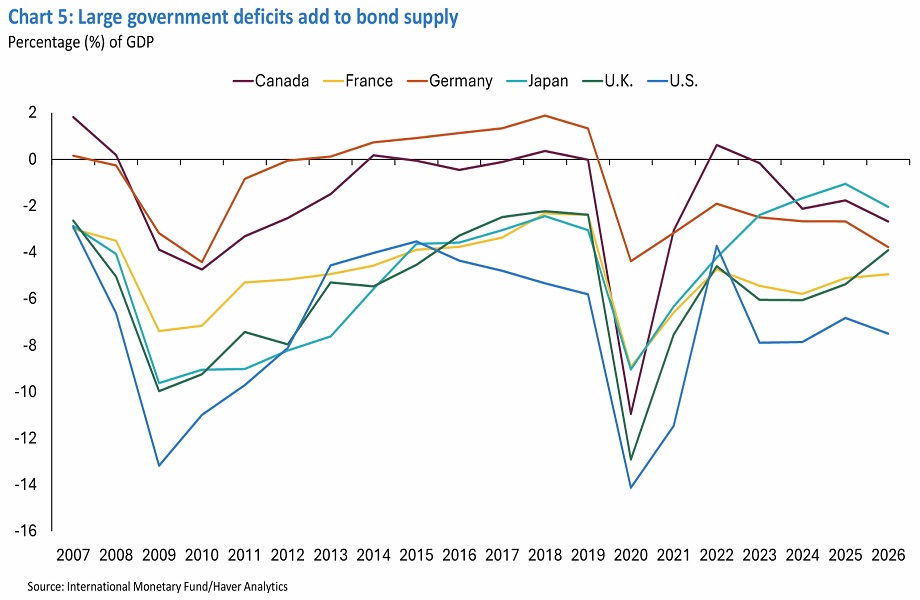
More competition for a smaller pool of capital would likely have gradually pushed yields higher. However, heavy borrowing by major governments—especially in the U.S.—has amplified the pressure by adding even more debt for the market to absorb.
After taking office in early 2025, the U.S. administration passed major fiscal legislation that cut taxes while maintaining significant spending in areas such as defence. IMF estimates put the U.S. deficit at 7.5% of GDP in 2026 (Chart 5). Across many countries, there also appears to be limited political appetite to cut spending or raise taxes. As debt-servicing costs rise and claims more of the U.S. budget than defence spending, market concerns are increasing and investors are demanding higher returns to finance and rollover large deficits.
Exceptional policy uncertainty has also pushed yields higher over the past 18 months. Since 2025, the U.S. administration has changed or challenged long-standing elements of fiscal and economic policy, including central bank independence, and questioned relationships with global partners that have anchored the global economy since the end of the Cold War. The uncertainty has unsettled investor expectations and increased the premium investors demand for committing capital (Chart 6).
Bond yields are rising for several interconnected reasons across multiple countries, making a quick or simple solution unlikely. Unless debt issuance slows, private-sector demand for capital eases or a new source of investment emerges, borrowing costs are likely to remain elevated. Thinner markets also mean policy or geopolitical shocks can move rates abruptly, even before central banks respond.
The global economy is moving from a decade of abnormally low interest rates into an environment of higher and more volatile borrowing costs. Governments, companies and consumers will need to adjust. For Canadian exporters, that means treating bond yields as a practical business indicator, rather than an abstract financial-market measure.
Want to understand what changing global financial conditions could mean for your business? Explore EDC Economics for the latest insights and analysis to help you navigate risk and make informed decisions.