Skip navigation
Stuart Burgman

How Canada can capture more value from innovation

The final whistle has blown on the FIFA World Cup, but much of its value remains. According to Brand Finance, FIFA’s brand is worth more than US$5.2 billion. That value comes not only from ticket sales, hospitality and the trophy itself, but also from trademarks, broadcasting rights, sponsorships, licensing deals and one of the world’s most recognizable brands. It’s a reminder that some of today’s most valuable assets are the ones we can’t see.

Why the intangible economy matters to Canada’s future

For much of the 20th century, economic success was built on tangible assets such as factories, machinery and natural resources. Today, value is increasingly created through software, patents, brands, data, research and development, and organizational know-how.

Unlike physical assets, intangibles can scale more easily and across more markets, transforming how firms compete. The central question is increasingly not where products are made, but who benefits from the ideas embedded within them.

How intellectual property drives growth, exports and profitability

Intellectual property (IP) is one of the most important forms of intangible capital. Patents, trademarks, copyrights, industrial designs and trade secrets help firms protect innovation and capture economic returns.

Research suggests intangible assets account for roughly 27% of the value captured in manufacturing global value chains. A 10% increase in intangible assets has been associated with roughly 3% higher profit margins, while intangible assets are estimated to have contributed 22% to Canada’s productivity growth since 2000.

The export connection is equally important. According to Statistics Canada and the Canadian Intellectual Property Office (CIPO), Canadian small- and medium-sized enterprises (SMEs) that formally own intellectual property are three times more likely to expand domestically and four times more likely to expand internationally.

Canada’s innovation challenge: Turning ideas into economic value

Canada is well positioned to succeed in an economy increasingly driven by intangible assets. The country benefits from strong universities, research institutions and a highly educated workforce. Canada has produced world-changing innovations, from insulin to artificial intelligence. Yet Canada faces what many economists call an innovation paradox. While Canada performs relatively well on measures of innovation, we can do more to translate those strengths into productivity growth, exports and enduring economic benefits at home. According to research by the World Intellectual Property Organization (WIPO), Canada ranks 13th globally for generating innovation, but 20th in translating innovation into economic activity.

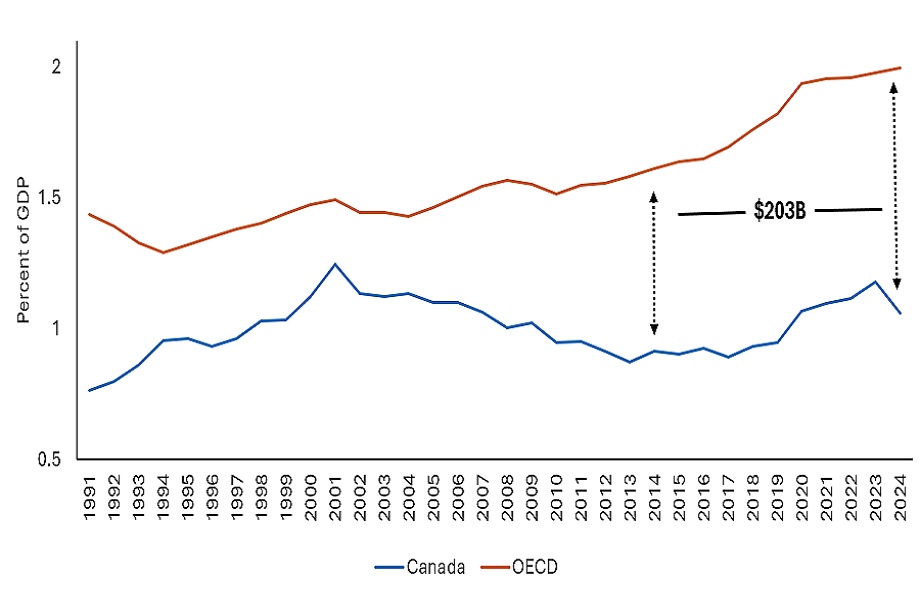
The gap is visible across several indicators. Over the past decade, Canada accumulated an estimated C$71 billion intellectual property trade deficit, reflecting the fact that Canadians pay far more for foreign IP than we earn from selling our own abroad. Business R&D investment also continues to lag peers, contributing to an estimated cumulative funding gap of roughly $203 billion relative to the Organisation for Economic Co-operation and Development (OECD) average. Some of the R&D is done by foreign multinationals that take the IP back to their home countries. Consequently, Canada generates innovative ideas, but too often the resulting economic returns accrue elsewhere.

Canada versus OECD business expenditure on R&D (BERD)

Source: OECD data

A major challenge with intangible assets is that they’re largely invisible, difficult to value and often absent from traditional financial statements. This makes it difficult for companies to borrow against them. Remedying this situation will require sustained co-ordination between the private sector, government and financial institutions.

The bottom line: Commercializing and scaling Canadian innovation

Canada must commercialize, scale and retain more ideas at home. For innovative firms, earlier development of intellectual property strategies, specialized advice, valuations and broader IP-backed financing would help them protect innovations, secure capital and expand globally.

Many of these themes are explored in EDC Economics’ recent white paper, From resources to resilience: How Canada can capture more value through trade, which outlines six priorities for strengthening Canada’s long-term competitiveness.

In the intangible economy, winning isn’t just about creating the next big idea. It’s about owning the value it creates.

This week, a very special thanks to Hassan Goreja, senior economist, and Adam Hasham Parwana, junior associate, in EDC Economics.

As always, at EDC Economics, we value your feedback. If you have ideas for topics that you’d like us to explore, please email us at economics@edc.ca and we’ll do our best to cover them.

This commentary is presented for informational purposes only. It’s not intended to be a comprehensive or detailed statement on any subject and no representations or warranties, express or implied, are made as to its accuracy, timeliness or completeness. Nothing in this commentary is intended to provide financial, legal, accounting or tax advice nor should it be relied upon. EDC nor the author is liable whatsoever for any loss or damage caused by, or resulting from, any use of or any inaccuracies, errors or omissions in the information provided.


Date modified: 2026-09-24