China Shock 2.0: What it means for Canadian exporters
Author details
Susanna Campagna
Principal Country Risk Analyst, Economic & Political Intelligence Centre (EPIC)
Sasan Fouladirad
Economist and country risk analyst, Economic Political Intelligence Centre
In this article:
- China Shock 2.0 is reshaping global trade
- From low-cost goods to advanced manufacturing
- Trade barriers and supply chains are shifting
- What China Shock 2.0 means for global trade
- China’s advanced industries are increasing global competition
- The U.S.-China AI race is reshaping global trade
- The bottom line for Canadian exporters
Key takeaways for Canadian exporters
- China Shock 1.0 was driven by low-cost consumer goods; China Shock 2.0 reflects China’s rise in advanced manufacturing and artificial intelligence (AI)-related technologies.
- Governments are responding to China Shock 2.0 with tariffs, trade barriers, industrial policies and economic-security measures, reshaping global supply chains and creating a more complex trade environment.
- China’s shift toward advanced manufacturing, AI and the clean-energy transition is changing its import needs, creating new opportunities and increasing competition for global firms.
- Canadian exporters will increasingly need to compete on innovation, expertise and supply chain efficiency rather than price, both in China and in emerging markets where Chinese firms are expanding.
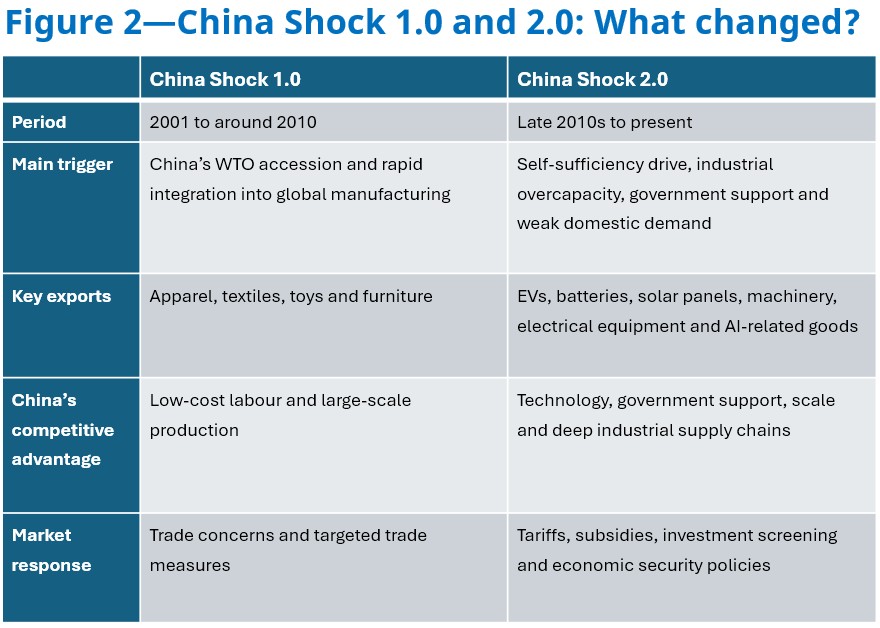
The original “China shock” followed China’s 2001 accession to the World Trade Organization (WTO). China’s rapid integration into global manufacturing brought a surge of low-cost exports, including apparel, textiles, toys and furniture. Production and assembly shifted to China, putting pressure on manufacturing employment in parts of the United States, Europe and other economies.
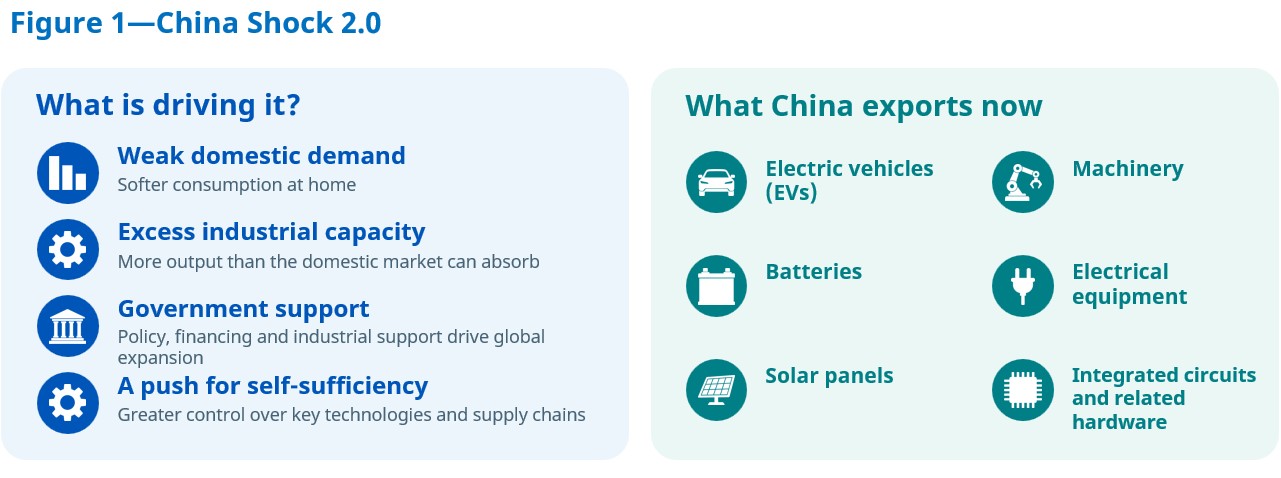
China Shock 2.0 describes a different phase. China is moving into higher-value, technology-intensive industries, supported by large-scale production, deep supply chains, industrial policy and rapid technological development. The result is a new export wave led by electric vehicles (EVs), solar panels, machinery, electrical equipment, semiconductors and AI-related hardware.
China’s entry into the WTO thrust the country into global supply chains, but the drivers of China Shock 2.0 are very different. The collapse of the domestic housing market in 2022, combined with slowing population growth, has weakened domestic demand.
Industrial policies and government support have also contributed to excess capacity in several key industries. At the same time, the central government has pursued greater self-sufficiency, helping drive technological advances and increasing China’s competitiveness in more complex, higher-value industries.
This combination of excess capacity, technological advances and greater reliance on domestic supply chains is fuelling a new wave of low-cost exports. Products such as autos, solar panels, advanced batteries and components used in computer and energy infrastructure are increasing competition in global markets.
China’s role in vital parts of global supply chains, including the refining and processing of critical minerals, has also increased its influence in global economic and political relations.
Governments are responding to China’s expansion in strategic industries with tariffs, subsidies, investment screening and economic security measures. These responses are contributing to a more protectionist global trading system, even as China advocates for free trade to support its own economic growth.
The effects of China Shock 2.0 vary considerably by market. In Europe, Germany has been particularly affected. Its export volumes to China fell by nearly 25% between 2019 and 2025, as China shifted its supply chains. German companies are also facing greater competition from Chinese firms in autos, machinery and other industrial sectors.
By contrast, Hungary, Slovakia and other parts of Central and Eastern Europe are attracting Chinese foreign direct investment (FDI) in EV and battery production. An estimated €15 billion to €20 billion (C$24 billion to C$31 billion) in FDI has been committed since 2023. This mix of competition and investment is creating different national interests, making it more difficult for the European Union (EU) to reach a common response to China’s export expansion.
In North America, the U.S. has responded by imposing increasingly high tariffs on Chinese imports since 2016. It’s also encouraged Canada and Mexico to adopt similar measures and industrial policies in response to Chinese investment.
In Latin America, the relationship is becoming more complex as Chinese passenger vehicle exports to the region have nearly doubled since 2023, while China remains a major market for the region’s copper, soybeans and other products.
In Southeast Asia, Thailand and other countries are attracting Chinese manufacturing investment while using incentives and local production requirements to retain more of the economic benefits. At the same time, domestic producers face greater competition from Chinese firms and imports.
Japan, by contrast, has focused more heavily on economic security, including strengthening domestic industries and reducing its dependence on China for critical technologies, materials and supply chain inputs.
Thank you for reaching out to EDC.
Please watch your inbox for our email.
Loading
Thank you for applying for coverage under your PSG Margin.
China’s changing economy is reshaping import demand
During China Shock 1.0, China’s rapid industrialization boosted global demand for commodities, energy and agri-food. Today, as China’s economy shifts from property-led investment toward advanced manufacturing, AI and clean energy, its import needs are changing. Demand is growing for energy, critical minerals and technology. Agri-food will also remain important as China prioritizes food security.
You should also check out
Discover opportunities, risks and regions for Canadian exporters doing business in China in 2026.
New opportunities in China for Canadian exporters
Export Development Canada’s (EDC) Canada’s top export markets and opportunities to 2035, by quantitative analyst Jean Gardy Victor, identifies where Canada’s goods and services exports are most likely to grow over the long term. The analysis ranks China as Canada’s largest goods export opportunity in Asia and Oceania by 2035.
Our Canada-China revealed comparative advantage (RCA) analysis identifies Canadian strengths in products such as wood pulp, canola, precious metal scrap, nickel and raw hides. Some of these strengths are well established, with canola, potash, chemical pulp and wheat remaining persistent areas of specialization, while others are changing.
EDC’s Doing business in China in 2026: Opportunities for Canadian exporters highlights opportunities in agri-food, cleantech and advanced manufacturing. It also identifies potential opportunities related to China’s growing AI-related energy demand, including grid technologies, long-duration energy storage, power electronics and cybersecurity.
Canadian firms will be best positioned to compete through innovation, specialized expertise and supply chain efficiency, rather than low-cost production.
“For Canadian companies, success in China isn’t about competing on price. It’s about bringing quality, innovation and specialized expertise to areas where Canada has a competitive advantage,” says Peter Xu, EDC’s senior regional manager for Greater China.
Looking for more insights on Asia-Pacific? Explore EDC’s Asia-Pacific market intelligence for opportunities and resources to help plan your expansion in the region.
China’s advanced industries are increasing global competition
China is rapidly emerging as a technology powerhouse, expanding its capabilities in EVs, batteries, solar panels, machinery and AI-related hardware. This growth is increasing competition for Canadian and other global firms, both in China and in markets around the world.
Unlike China Shock 1.0, Chinese companies now compete directly with exporters from advanced economies. Excess capacity, weak domestic demand and ongoing trade barriers imposed by the United States and Europe mean China continues to seek buyers overseas, redirecting some exports and direct investment toward emerging markets. China’s export push is putting pressure on prices and market share in many of the same markets where Canadian and other global companies are seeking growth.
Want a deeper look at China’s risk outlook? Explore EDC’s Country Risk Quarterly for the latest economic indicators, trade data and country risk insights.
The U.S.-China AI race is reshaping global trade
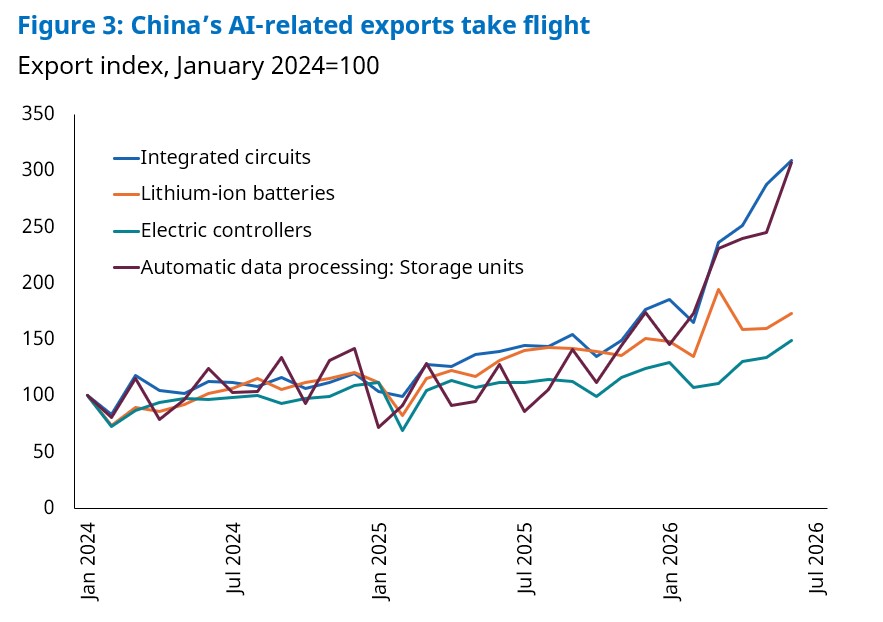
China’s AI-related exports are growing rapidly. China Shock 2.0 is unfolding against a broader U.S.-China technology race. Competition over AI, semiconductors and other strategic technologies is reshaping global supply chains and creating distinct technology and trade blocs. As a result, Canadian and other global firms could face higher costs, more complex sourcing decisions and pressure to navigate competing standards, suppliers and markets.
Source: EDC Economics and Haver Analytics
China Shock 2.0 extends beyond overcapacity and price competition. China’s role in advanced manufacturing and the global race in advanced technologies will significantly shape supply chains, commodity demand, industrial policy and geopolitical relationships in the years ahead.
For Canadian exporters, the message is clear: China’s changing economy is creating new sources of demand and opportunity. At the same time, persistent excess capacity and the rapidly advancing capabilities of Chinese firms are increasing competition in global markets, putting greater pressure on prices, market share and profitability.