When people think about exports, they picture containers on ships, wheat in rail cars, or energy products moving through pipelines. But Canada’s trade story is much bigger than goods—it includes services exports and Canadian direct investment abroad (CDIA), which is reshaping global competitiveness.
While more than 75% of Canada’s goods exports typically head to the United States, CDIA is relatively more diversified. According to Statistics Canada, of the $2.47-trillion CDIA stock in 2024, 52% went to the U.S.
One key driver of CDIA is mergers and acquisitions (M&A)—when companies combine or one buys another. These deals help firms expand internationally, enter new markets and strengthen supply chains. Learn how businesses use M&A as a growth tool.
While CDIA reflects Canadian firms investing abroad, the flipside of the coin is foreign direct investment (FDI), which is when foreign companies invest in Canada. Both CDIA and FDI are an important part of international trade and diversification.
According to Global Affairs Canada, investing abroad helps businesses strengthen their presence, enter new markets and access international resources and skills. By the numbers, the U.S. and Canada are significant investment partners.
For decades, CDIA and FDI operated in a stable trading environment. But since the start of 2025, the new U.S. administration has introduced major trade and economic policy changes. What has this done to a specific type of direct investment—M&A?
Research from the National Bureau of Economic Research’s report, Cross-Border Mergers and Acquisitions, suggests that strained trading relationships between countries leads to less M&A activity. It also indicates that companies pursue cross-border M&As to avoid paying tariffs by operating directly within the tariff-imposing country—resulting in fewer exports. Developments since early 2025 have created uncertainty about how companies are responding.
You should also check out
Insights and analysis from EDC on navigating the U.S. business environment
To get a sense of how Canadian companies are reacting to the trade uncertainty, we analyzed cross-border M&A trends by counting the number and disclosed value of announced M&A deals between Canadian and U.S. firms.
Using data from S&P’s Capital IQ Pro, our analysis covers the period between February and August 2025 and compares that timeframe to the same seven-month window between 2019 and 2024.
While the impact on M&A activity and findings will evolve as more data becomes available, this provides an early look at the influence policy uncertainty and changes may be having. Our analysis shows:
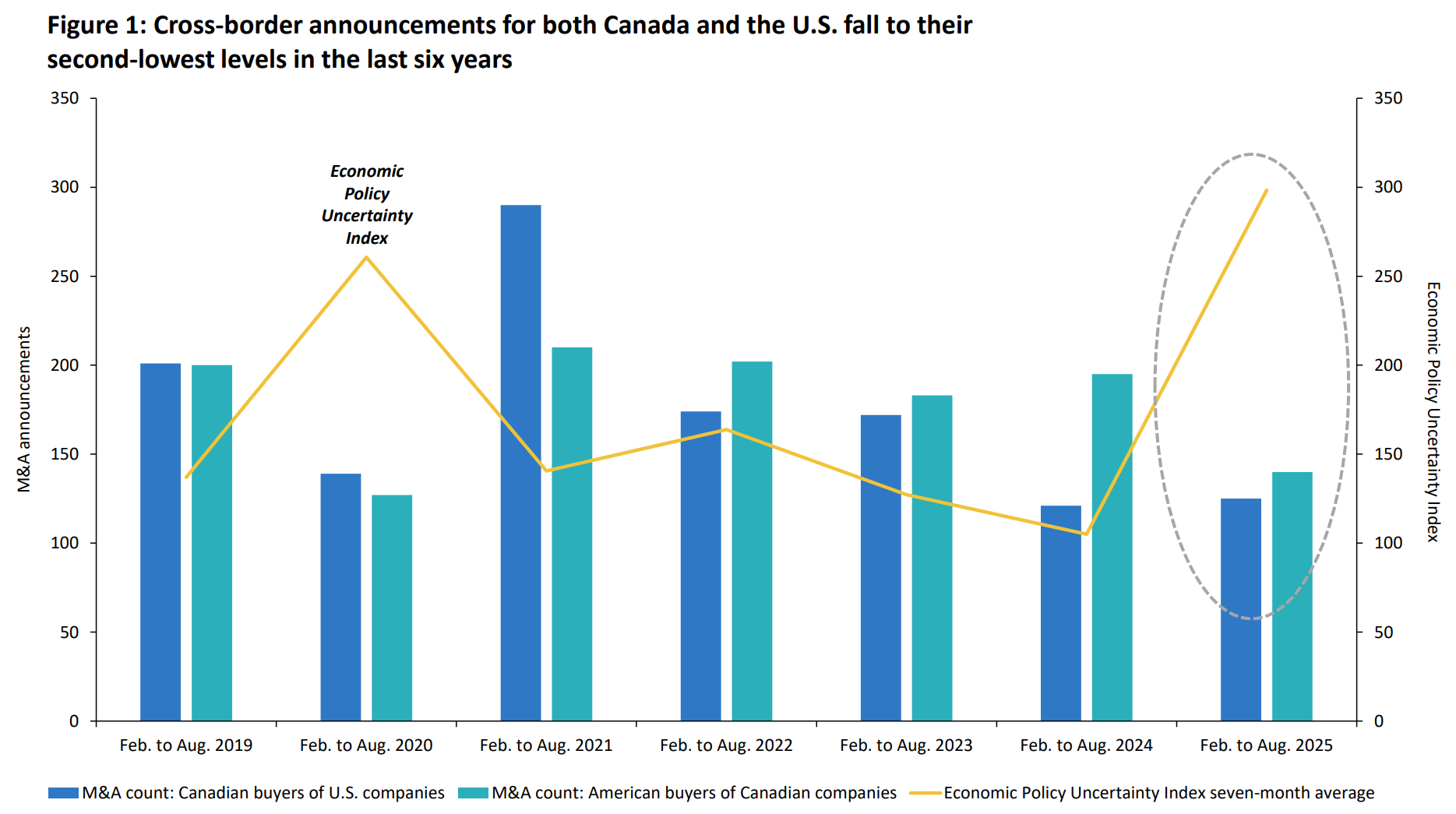
- Compared to recent history, there have been fewer Canadian companies buying U.S. firms—51 announced deals less than the average over the past five years (2019 to 2024)—representing a 29% decrease. However, the total disclosed value of these deals increased 10% (US$2.7 billion), signalling some larger transactions in 2025.
- Across the border, activity from U.S. companies buying Canadian firms fell by 44 announced deals compared to the five-year average, representing a 24% decrease.
- However, the disclosed value of announced M&A transactions was more than double the five-year average value, suggesting that U.S. companies may not be facing the same headwinds as Canadian ones (Figure 1).
Source: S&P Capital IQ Pro and PolicyUncertainty.com/Haver Analytics
M&A is more than a financial transaction—it’s a strategic tool for global business expansion. Explore how Canadian companies leverage M&A to reach global success and follow a real-world merger with Quebec aerospace company, Adipa International.
Early M&A data: Insights into Canada’s evolving trade and investment strategy
The early data suggests that U.S trade and economic policy uncertainty is having an impact on M&A deal activity. However, how much of an impact and how long these changes will persist is unknown. As we get further away from U.S. policy changes and deeper into the term of its administration, it’ll be important to review this data and update assessments in the months ahead.
Although often overlooked in export discussions, CDIA is an important part of Canada’s trade mix. Keeping an eye on trends in M&A and CDIA can show how Canadian companies are navigating an evolving and complex trade environment. To assess your company’s readiness for mergers and acquisitions, read our M&A checklist article.
Export Development Canada (EDC) can help Canadian companies navigate cross-border mergers and acquisitions with expert advice to support global growth. Check out these additional resources:
- U.S. market intelligence: Get the latest economic and trade insights for Canada’s top trading partner.
- Export Help Hub: Connect with EDC trade advisors for guidance on market strategies, regulations and customs.
- Business Connections Program: Promote Canadian export capabilities to international buyers.
- Risk management solutions: Access financial tools, including the Country Risk Quarterly.
Stay informed on the Canada-U.S. business environment by contacting your EDC relationship manager or calling 1-800-229-0575.