Canada needs a services strategy for long-term trade growth
Author details
Meena Aier
Senior Economist, Research and Analysis Department, EDC Economics
In this article:
- Key takeaways: Services exports are powering growth, value and jobs
- Where services exports are concentrated in Canada
- How Canada’s services exports have performed over time
- Do services exports increase Canadian income and productivity?
- How services exports drive productivity and enable goods trade
- Where Canada’s services exports are growing fastest
- How EDC can help
Part 2 of EDC Economics’ series on Canada’s long-term trade competitiveness.
Canada’s trade story is changing. While goods have long dominated exports, services are now driving growth, value and jobs at home. Yet, services exports remain under-emphasized in trade discussions and business strategy.
For exporters, this shift matters. Services exports are often more scalable, less constrained by geography and increasingly embedded in global value chains. They also play a critical role in enabling goods exports—from transportation and logistics to digital and professional services.
“Services are increasingly where value is created and where future export growth will come from,” says Stuart Bergman, chief economist at EDC.
This article examines how services exports are reshaping Canada’s trade performance, where the biggest opportunities lie and why a more deliberate national strategy is needed to support long-term growth, diversification and resilience.
- Canada’s export growth story has become a services story.
- Over the past decade, services exports delivered 87% of Canada’s real (inflation‑adjusted) export growth.
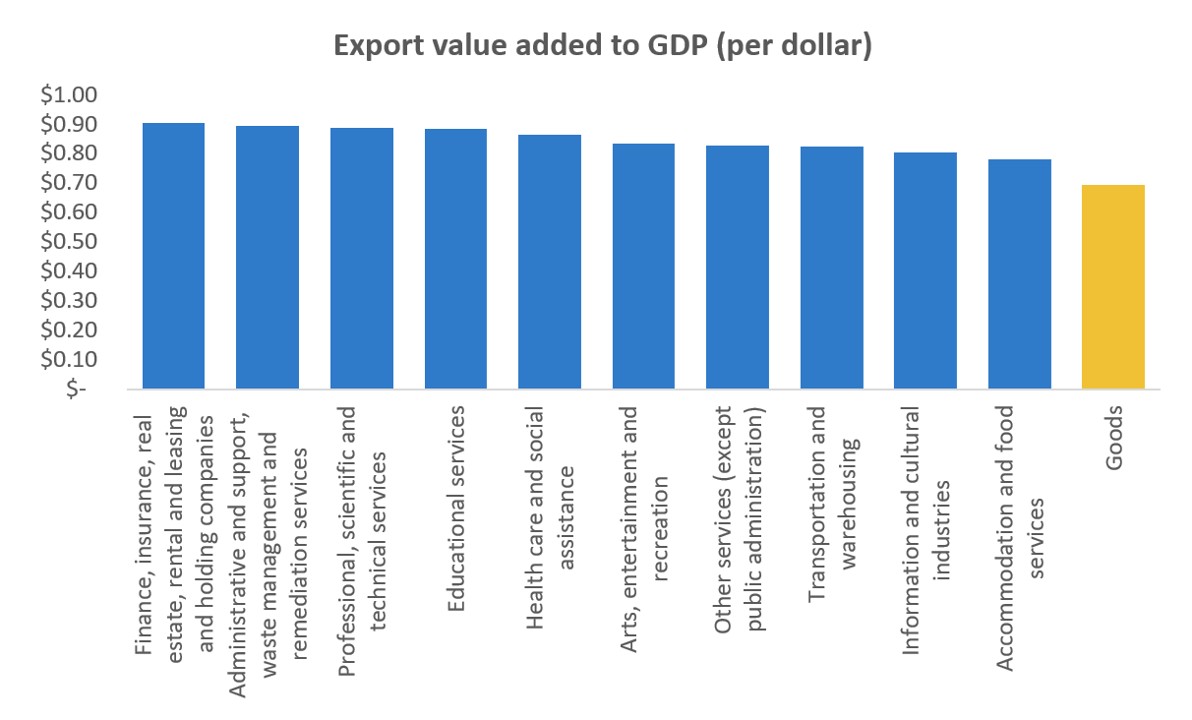
- The sector generates more value at home—every $1 of services exports adds 86 cents to Canadian gross domestic product (GDP), compared with 69 cents for goods.
- Services drive stronger gains in national income because they typically require fewer imported inputs, have higher profit margins and employ high-skill workers.
- Not all services are equal. For example, every dollar of exported accommodation and food services adds 78 cents to GDP, compared with 89 cents for professional, technical and scientific services.
- 1.9 million jobs are embedded in Canada’s services exports, accounting for 49% of all jobs linked to exports.
- Services strengthen manufacturing competitiveness, accounting for nearly 53% of the global value embedded in manufacturing exports.
- Trade relies on services—transportation, logistics and infrastructure make global trade possible.
- According to EDC’s mid-year 2026 Trade Confidence Index (TCI) survey, led by Jennifer Topping and EDC’s Customer Experience team, Canadian businesses that export both goods and services recorded a TCI score of 75.5, compared with 68.6 for businesses that export only goods. Exporters that pair goods with services appear better positioned to capture revenue from multiple sources, build deeper customer relationships and create greater resilience through integrated trade models.
- Services exports are more diversified than goods exports—about 47% are sold outside of the United States.
- According to the recent TCI survey, exporters that sell both goods and services are the most active participants in the broader trade ecosystem, reporting the highest intentions to diversify (80%), the greatest incidence of foreign investment (47%) and the strongest engagement in integrative trade activities overall.
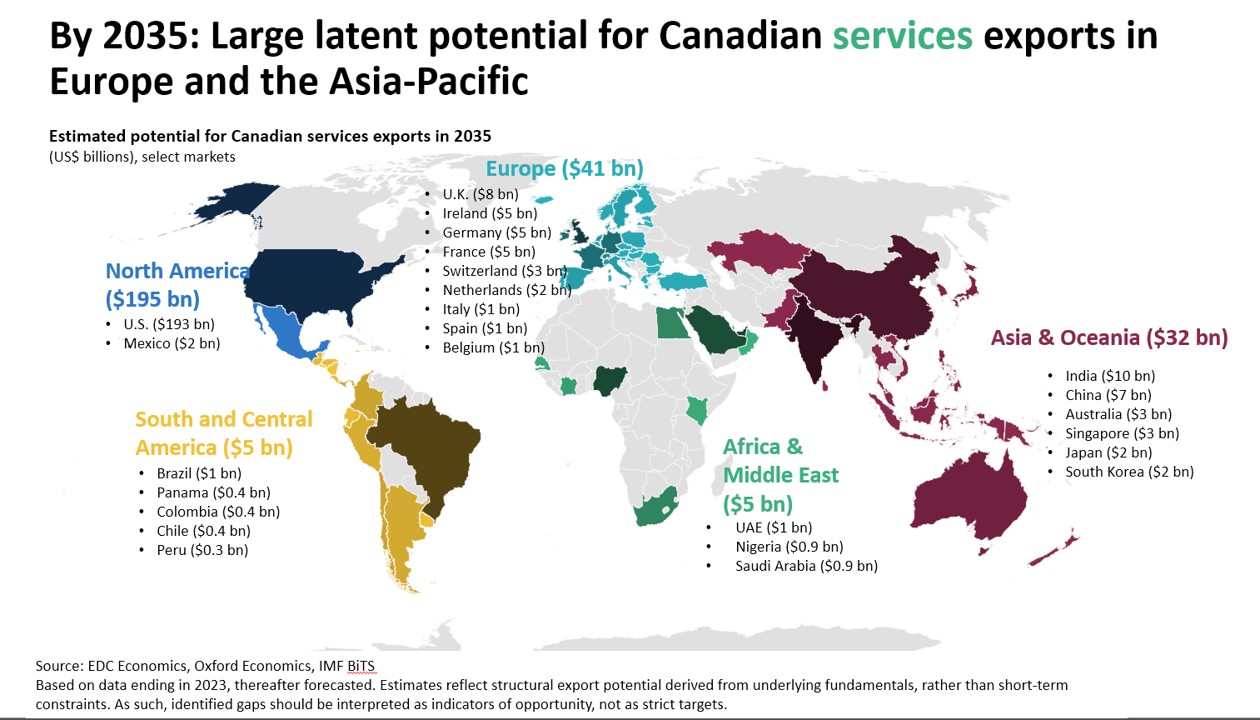
- By 2035, Canada’s services exports could reach US$272 billion, up from US$176 billion in 2025. Many of the largest opportunities are in Europe, including Ireland, the United Kingdom (U.K.), Germany, Italy, Spain, Belgium, Austria, Poland, Sweden, Norway and Denmark.
- Despite this, services exports receive far less attention in Canada’s trade discussions.
- Export growth in the first quarter of this century has been driven largely by services. Given the rapid advances in artificial intelligence (AI) and potential breakthroughs in quantum computing, it’s likely that services will underpin global economic growth over the coming decades.
- Canada’s services growth has slowed over the past two years, with real services exports declining for the first time since the pandemic. Between 2024 and early 2026, Canada’s real, inflation-adjusted services exports experienced negative growth in six quarters.
- Services are key to building competitive advantage in manufacturing. Digitally delivered services offer strong scaling potential and support diversification.
- In a period of trade uncertainty and geopolitical tensions, services can help build a more resilient and competitive economy.
You should also check out
EDC’s flagship white paper on strengthening Canada’s competitiveness, value capture and long-term growth through global trade.
What services exports are and how they work in practice
How services exports are delivered across borders
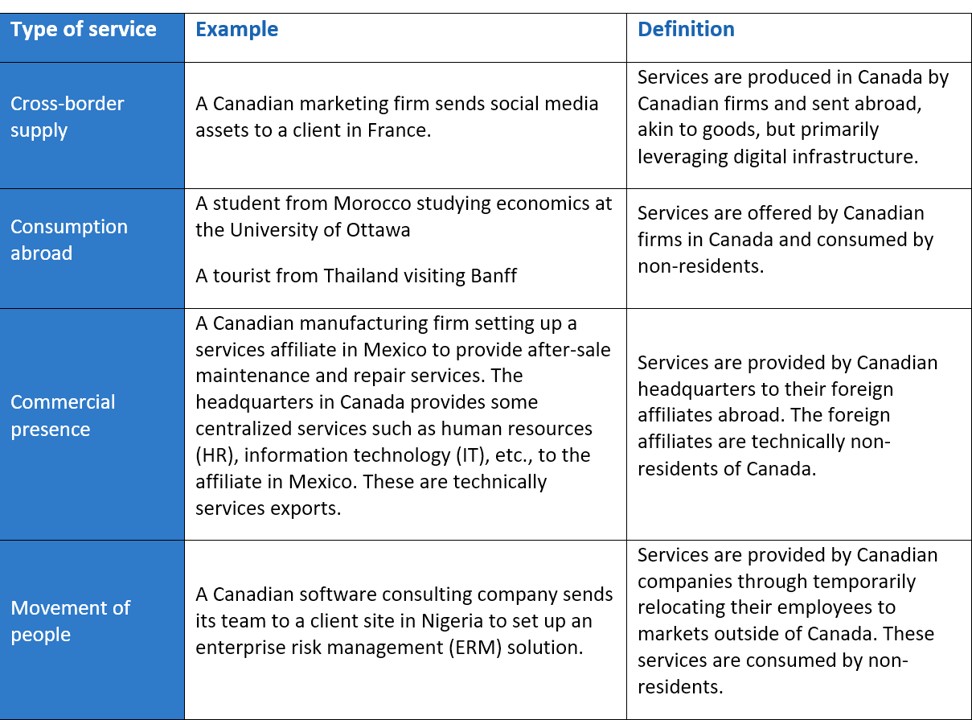
Services exports are defined not by physical movement, but by how value crosses borders. They fall into four categories: Cross-border supply, consumption abroad, commercial presence and the movement of people.
Canadian services exports in space: A real-world example of borderless trade
Services exports aren’t constrained by geography. They can even extend into space.
Canada’s long-standing contributions to the International Space Station (ISS) have helped advance innovation with real-world applications. The Image Guided Autonomous Robot (IGAR), for example, works with MRI scanners to help radiologists perform highly precise biopsies while removing minimal tissue.
These capabilities build on Canada’s expertise in space robotics. The Canadarm was revolutionary in the 1970s and 1980s, while Canadarm3 is designed to operate with minimal human intervention—enabled by advances in artificial intelligence, machine learning and machine vision.
While systems such as the IGAR and Canadarm are manufactured goods, much of their value is driven by underlying software, intellectual property and research.
In this sense, services—particularly digital and knowledge-based services—are increasingly powering global trade. They’re scalable, less constrained by geographical borders and able to evolve across industries and markets.
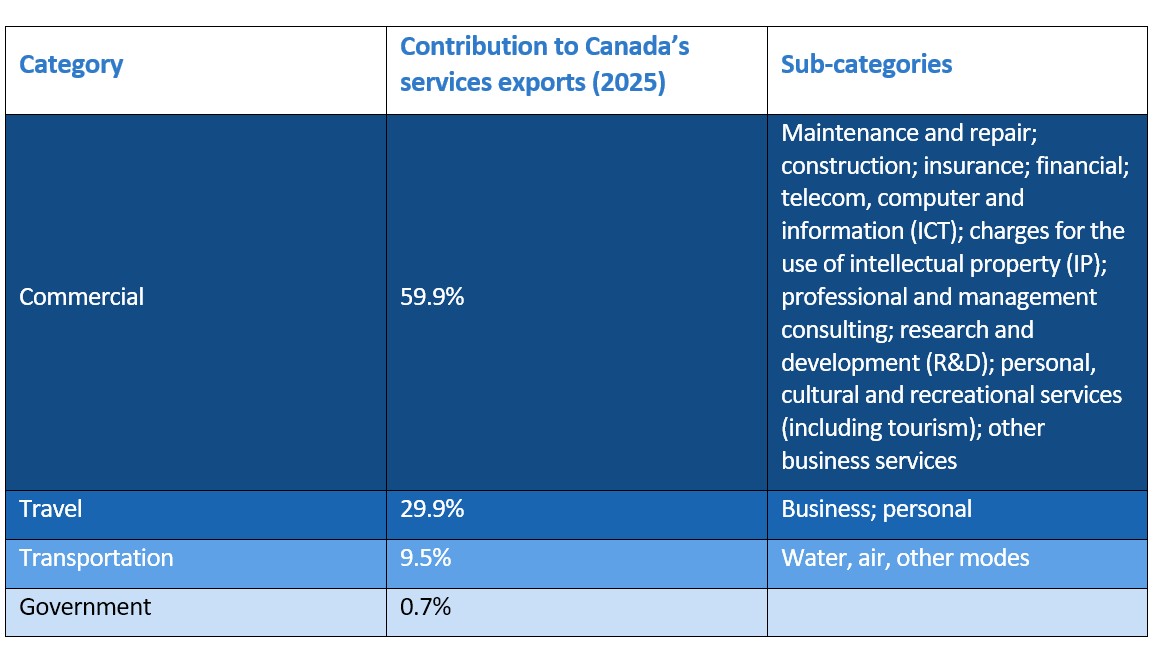
From a data perspective, services exports fall into four main categories: Commercial, transportation, travel and government services. Commercial services dominate, accounting for nearly 60% of total exports, followed by travel and transportation.
A decade of strong growth driven by services
In 2025, services accounted for 75% of Canada’s real GDP. Services exports reached C$240 billion, representing 24% of Canada’s total exports, up from 18% in 2016.
Canada also maintained a modest trade surplus, exporting about $3 billion more in services than it imported.
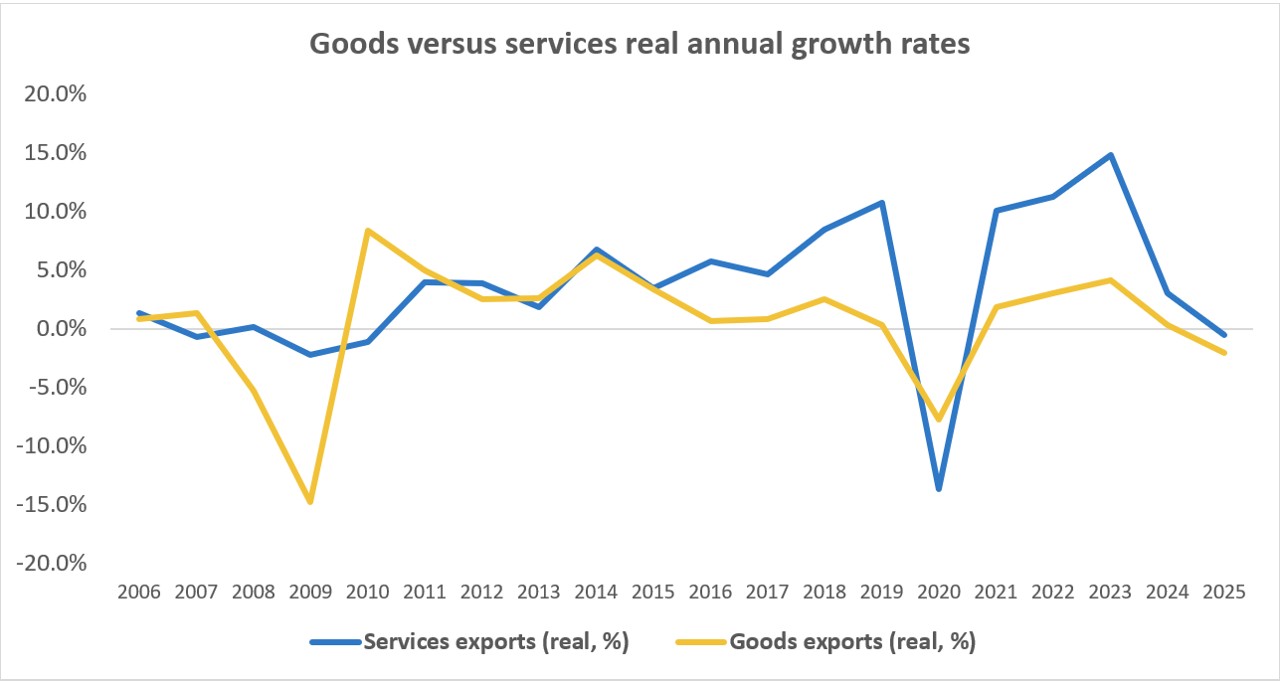
Over the past decade, services exports have outpaced goods exports by a wide margin:
- Nominal services exports grew at a compound annual growth rate (CAGR) of 7.6%, compared with 4% for goods.
- Real services exports grew at a CAGR of 4.6%, compared with 0.3% for goods.
- Services accounted for 87% of Canada’s real export growth over this period.
This points to a structural shift: Real export growth is increasingly driven by services, while goods exports have been more influenced by prices.
However, there are early signs of slowing momentum. Real services exports declined in six of the nine quarters between 2024 and the first half of 2026. See Canada’s export outlook 2026 for a broader view of Canada’s export performance and risks.
Figure 1: Canada’s real, inflation-adjusted goods and services exports: Annual growth rates
Sources: Statistics Canada, Haver Analytics, EDC Economics
Commercial services: Canada’s largest and most scalable export segment
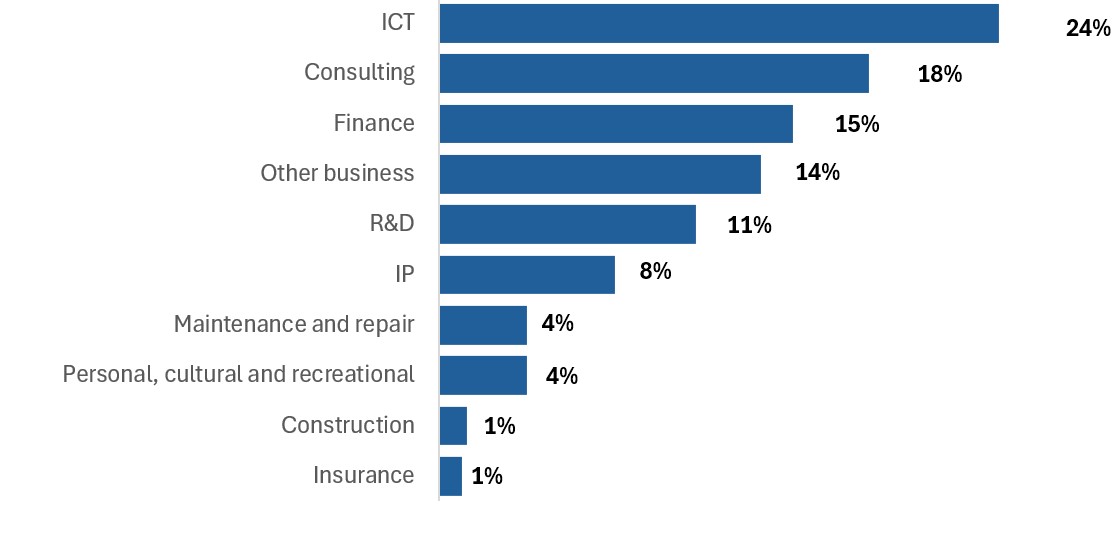
Figure 2: Components of Canada’s commercial services (2025)
Sources: Statistics Canada, Haver Analytics, EDC Economics
Commercial services are Canada’s second-largest export category after oil and gas, accounting for 61% of nominal services export growth over the past decade and growing at a CAGR of 7.8%.
Their resilience during COVID-19 underscores a key advantage—many can be delivered digitally, allowing firms to scale across borders.
What’s next: AI presents both opportunity and risk. While AI may expand digitally delivered services, it could also commoditize certain knowledge-based activities such as software coding and data analysis.
Thank you for reaching out to EDC.
Please watch your inbox for our email.
Loading
Thank you for applying for coverage under your PSG Margin.
Travel services: Strong growth with higher exposure to shocks
Travel services accounted for nearly 30% of Canada’s overall services exports in 2025 and grew at 9.1% annually over the past decade.
However, this growth is more volatile. The sector is highly exposed to external shocks, including pandemics, currency fluctuations and geopolitical risks. Recent trends have also been influenced by non-permanent residents, particularly from countries such as India.
Tourism remains a major economic contributor, generating more than $104 billion in revenue in 2024 across nearly 267,000 businesses. More notably, real tourism GDP grew by 2.2% in Canada in 2025, compared with 1.6% for the overall economy. While tourism represents a relatively small share of GDP, it has grown steadily and presents long-term potential.
Transportation services exports: The backbone of trade diversification
Transportation services—accounting for about 10% of Canada’s services exports in 2025—play a critical role in enabling trade.
They support the movement of goods across global markets through ports, rail, freight and passenger transport, as well as warehousing, storage and logistics services. Together, they form a core part of Canada’s trade-enabling infrastructure.
Between 2016 and 2025, Canada’s transportation services exports grew at a CAGR of 3.5%—considerably slower than travel and commercial services. Expanding capacity—especially for east-west trade—will be critical to diversification.
Direct impacts: Higher value added at home
Services exports generate significantly more domestic value than goods. In 2023, every dollar of services exported contributed about 86 cents to GDP, compared with 69 cents for goods.
Figure 3: Export value added to GDP, select services versus overall goods
Sources: Statistics Canada, EDC Economics
Services contribute more to national income because they typically require fewer imported inputs, generate higher profit margins and employ high-skill workers. Their position in more knowledge-intensive parts of the value chain also supports stronger domestic gains.
Some sectors go even further. Professional, technical and scientific services generate nearly 89 cents per dollar exported, reflecting the expertise required and the potential for intellectual property creation and retention.
Not all services are equal. For example, accommodation and food services—given their reliance on physical infrastructure and imported inputs—generate roughly 78 cents per dollar exported.
Services exports also support jobs. In 2023, they accounted for 1.9 million jobs, or 49% of total export-related employment, up from nearly 43% in 2016.
Related report: From resources to resilience: How Canada can capture more value through trade
Services are a growing source of value creation for the Canadian economy. But they’re only one part of a broader conversation about how Canada captures more value from global trade. Explore EDC Economics’ white paper on economic complexity, global value chains and six priorities that could strengthen Canada’s long-term competitiveness. The report explores why Canada’s trade strategy should focus not only on growing exports and diversifying markets, but also on capturing more value from trade.
Services exports play a critical role in the broader economy because they enable goods exports by providing the infrastructure and logistics required to move products to global markets. As Canadian firms expand into Europe, Asia, Latin America and Africa, they also rely on a full ecosystem of services, generating upstream spillovers across global value chains. Services inputs account for nearly 53% of the value embedded in manufacturing exports.
In Organisation for Economic Co-operation and Development (OECD) economies, services play a critical role in upgrading manufactured goods. Support functions—such as R&D, IT and after-sales services—account for 25% to 60% of employment in manufacturing firms.
“Services are deeply embedded in how modern economies produce and trade—they’re not separate from goods, they’re integral to them,” says Stuart Bergman, chief economist at EDC.
Services subsectors—especially business services—tend to demonstrate higher productivity growth due to their knowledge-intensive nature. In Canada, post-COVID-19 gains in information and communications have driven productivity improvements.
For smaller firms, services offer a more accessible entry point into global markets. In 2024, small- and medium-sized enterprises (SMEs) accounted for close to 50% of services exports, compared with 40% for goods. They are particularly active in high-value subsectors such as professional, scientific and technical services, as well as information and cultural service providers.
The United States remains the No. 1 destination for Canada’s exports, accounting for nearly 53% of services exports in 2025—significantly lower than its share of goods exports, at 72%.
Beyond the U.S., key markets such as India (6.3%), the U.K. (about 5%) and China (4.1%) were the next-largest destinations for Canada’s services exports in 2025. European markets—notably France, Germany and Switzerland—also featured prominently. Other key markets included Mexico, Australia, Hong Kong, Japan, the Netherlands, South Korea, Singapore, Belgium and Brazil.
According to the latest Trade Confidence Index, 52% of services exporters report at least a moderate dependency on U.S. sales, compared with 67% of goods exporters. Services exporters and businesses that export both goods and services have also been less affected by recent declines in U.S. sales. Only 25% and 28%, respectively, reported decreases over the past six months, compared with 40% of goods-only exporters. These findings suggest that exporters with more diversified revenue streams, particularly those combining goods and services, may be better insulated from market volatility and better positioned to manage risk while maintaining growth.
Canadian businesses that export both goods and services increasingly view diversification and participation in multiple forms of trade as key to growth, with an overwhelming majority (80%) planning to expand into new markets over the next two years.
These diversification intentions highlight the untapped potential for Canadian services exports across a wide range of markets. By 2035, Canada’s services exports could reach US$272 billion, up from US$176 billion in 2025. This estimate reflects potential based on global economic growth trends and assumes no structural changes in Canada’s services exports. It doesn’t account for AI or policy shifts related to sovereignty, making it a conservative outlook.
In the years ahead, Europe represents one of the largest growth opportunities. Markets such as Ireland, the U.K., Germany, Italy, Spain, Belgium, Austria, Poland, Sweden, Norway and Denmark are expected to drive much of this expansion. Other opportunities include Singapore, Australia, Japan, the United Arab Emirates (UAE), Saudi Arabia, Brazil, South Korea and Malaysia.
Figure 4: Top markets of opportunity for Canadian services exports (2035)
Services exports are central to Canada’s economic future. Over the past decade, services exports delivered 87% of Canada’s real (inflation-adjusted) export growth, generated more domestic value (86 cents per dollar exported versus 69 cents for goods) and supported 1.9 million jobs, or 49% of export-related employment.
Looking ahead, Canada’s services exports could reach US$272 billion by 2035, up from US$176 billion in 2025, with many of the largest opportunities outside the U.S., particularly in Europe.
Yet, policy attention hasn’t fully caught up with this shift.
According to the recent TCI, services exporters are less likely to prioritize free trade agreements (FTAs) and rely more on the ease of doing business when it comes to market entry decisions. They also face an array of financial and non-financial challenges.
On the financial front, a volatile exchange rate tops the list, followed by rising business expenses and concerns around maintaining profitability. On the non-financial front, Canadian services exporters are, for the moment, less impacted by tariffs—but still concerned about broader global economic conditions and geopolitical risks. Separately, services exporters are also keeping an eye on AI adoption, which could present both upside and downside risks.
“Canada has a real opportunity to lead in high-value services, but it will require a more deliberate approach,” Bergman says.
Treating services exports as a core trade priority and addressing the barriers facing services firms will be critical to improving productivity, supporting market diversification and sustaining long‑term growth in an increasingly uncertain global economy.
EDC provides market intelligence, financing and risk management solutions to help Canadian exporters navigate global uncertainty. Businesses facing tariff pressures or trade disruption can explore EDC’s Trade Impact Program (TIP), which provides expanded financing, working capital support, trade credit insurance and foreign exchange solutions. Companies can also access EDC’s U.S. market intelligence hub for insights, market information and resources to help navigate tariffs and trade uncertainty. Exporters can also use tools such as the Country Risk Quarterly or connect with an EDC advisor to support their growth strategy.