One year later: How U.S. tariffs reshaped Canada-U.S. trade
Author details
Karicia Quiroz
Economist | Country & Sector Intelligence
In this article:
- How U.S. tariffs reshaped global trade and supply chains

- Canada-U.S. trade impact: Why services helped offset tariffs
- CUSMA and U.S. tariffs: Why compliance costs are rising
- Where U.S. tariffs hit Canadian industries hardest
- Canadian manufacturing under pressure from U.S. tariffs
- Canada-U.S. trade outlook: What exporters should watch next
- How EDC helps Canadian exporters manage U.S. tariff risks
In early 2025, new tariffs imposed by the United States began reshaping its trade relationship with Canada and other global partners, creating uncertainty and volatility across global supply chains. One year later, the impact is clearer: Most Canada-U.S. trade still flows duty-free through the Canada-United States-Mexico Agreement (CUSMA), but specific sectors, including metals, automotive and forestry, have been hit hard.
Looking back, we’ll examine how Canada’s experience compares with global competitors and where Canada is headed next.
Despite a wave of U.S. tariffs—first aimed at Canada, Mexico and China before expanding to almost every country, territory and island on April 2, 2025—global trade carried on. Global merchandise trade volumes increased 4.4% year-over-year (y/y) in 2025, despite uncertainty from frequent U.S. policy changes and rising protectionism.
Tariffs did, however, reroute trade. U.S. goods imports rose nearly 5% y/y in 2025, with less sourced from China and more from other Asian suppliers.
For Canadian exporters, this shift is significant: U.S. demand didn’t weaken in 2025, but tariffs and uncertainty made buyers more cautious about where and how they sourced goods. Globalization didn't reverse, but supply chains adjusted.
Against this backdrop, Canadian exporters entered 2026 with measured caution. Export Development Canada’s (EDC) Trade Confidence Index shows that exporters’ trade confidence rose to 69.7 by the end of 2025, four points higher than mid‑year, but still below its historical average. At the same time, many exporters are looking beyond the U.S. for growth, with Europe and the Asia‑Pacific emerging as the top regions for near‑term diversification.
Insights and analysis from EDC on navigating the U.S. business environment
Tariffs apply to physical goods—but that doesn’t tell the whole story for Canada. When services are included, Canada’s exposure to the U.S. looks more balanced, helping to offset some of the weakness in goods trade. These services include travel and transportation, commercial services such as finance, insurance, professional and digital services and government services.
According to Statistics Canada, in 2025:
- Canada’s goods and services exports grew 0.7% y/y, held up by services (3.7% y/y) even as goods dipped slightly (-0.2% y/y).
- Canada’s goods and services exports to the U.S. fell (-3.8% y/y), as a drop in goods exports (-5.7% y/y) outweighed the increase in services exports (6% y/y), reflecting the heavy weight of goods in Canada-U.S. trade.
- The U.S. share of Canada’s goods and services exports fell from 70% in 2024 to 67%.
- The U.S. share of goods exports fell from 76% to 72% over the same period.
- The U.S. share of services exports edged up slightly from 52% in 2024 to 53%.
Overall, service exports softened the blow. Export growth to non-U.S. markets offset declines to the U.S., though some of that strength was driven by higher gold shipments. Services helped, but tariff shocks still hit key manufacturing industries hard, especially those that are both export-intensive and U.S.-trade dependent.
CUSMA shields much of Canada-U.S. trade, but “tariff-free” doesn’t always mean “cost-free.” Exporters face higher compliance burdens, shifting rules, customer hesitation and more uncertainty. CUSMA compliance is essential to avoid steep tariffs, but can be complex and costly.
The Bank of Canada’s quarterly Business Outlook Survey shows that uncertainty goes beyond paperwork. Firms reported weak sales growth over the past year due to trade tensions. While investment intentions improved slightly, many prioritized maintenance activities over expansion as uncertainty and soft demand held back bigger commitments.
While many goods exports entered duty-free under CUSMA, products impacted by U.S. tariffs—including sectoral measures such as Section 232 tariffs—faced much higher costs and disruption. Given the distribution of industry across Canada, the impacts have been uneven and concentrated, particularly in Ontario and Quebec.
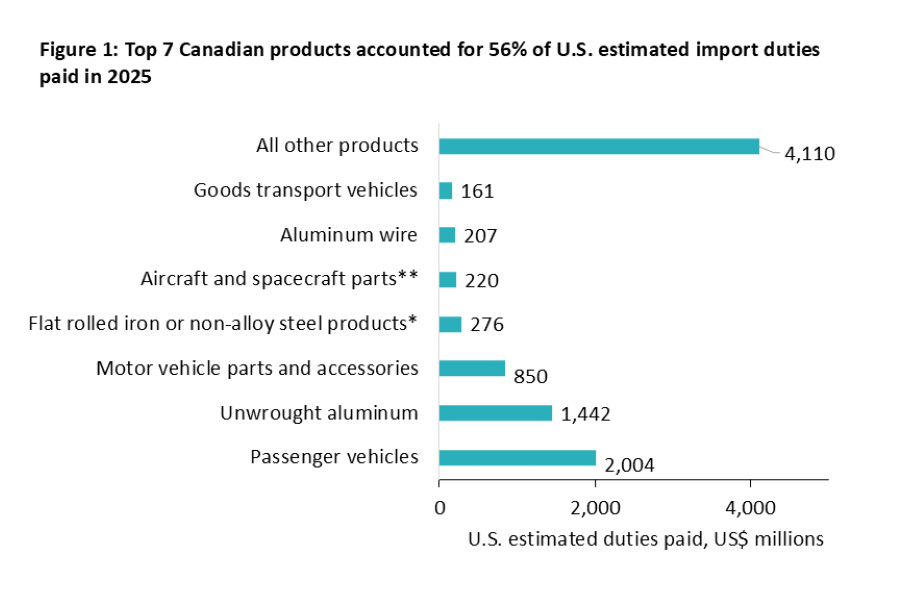
In 2025, a relatively small group of products accounted for about 56% of total duties paid by U.S. importers on Canadian goods—led by passenger vehicles, unwrought aluminum, motor vehicle parts and certain steel and aluminum products (Figure 1).
*Of a width of 600 mm or more, that are clad, plated, or coated.
**Includes parts for balloons and non-powered aircraft, powered aircraft and spacecraft and unmanned aircraft.
Sources: U.S. Census Bureau, EDC Economics
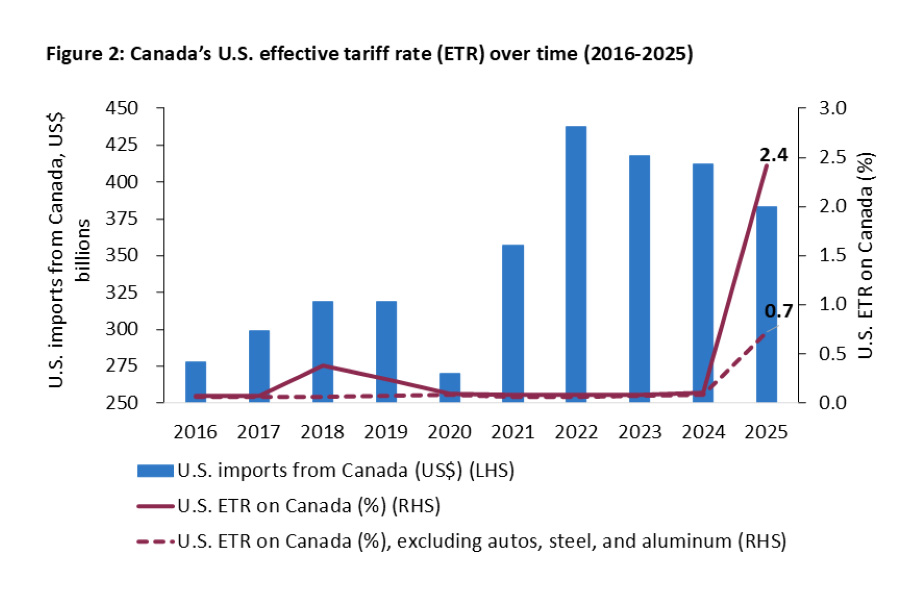
The U.S. effective tariff rate (ETR)—duties paid as a share of U.S. imports from Canada—reinforces this picture (Figure 2):
- The U.S. ETR on Canada jumped to 2.4% in 2025, much higher than the historical average of 0.1%.
- Excluding autos and parts, steel and aluminum lowers the ETR substantially to 0.7%, showing that the tariff shock remains highly concentrated.
Canada and the U.S. are tightly connected through integrated supply chains. In industries such as automotive manufacturing, parts and components can cross the Canada-U.S. border multiple times—sometimes up to eight—before a finished vehicle is assembled. As a result, tariffs can be applied at several stages of production, amplifying their impact in tightly integrated manufacturing chains.
Canada was the second-largest source of U.S. goods imports in 2025 (Figure 3), but its share slipped from 12.6% in 2024 to 11.2% in 2025, alongside an overall drop in U.S. goods imports from Canada. This suggests some softening in Canada’s competitiveness, even as overall U.S. import demand remained resilient.
U.S. import growth in 2025 was concentrated in electronics, data-processing equipment, communications technology and related components, benefiting countries such as Mexico, Taiwan and Vietnam.
Simultaneously, U.S. imports declined in sectors where Canada is more heavily concentrated, including energy products, vehicles and steel and aluminum products.
With CUSMA’s mandatory review set to occur in July 2026, these shifts take on further importance. Under the agreement, Canada, the U.S. and Mexico will formally assess whether CUSMA is still working as intended and decide by consensus whether to extend it for another 16 years or move into annual reviews. For more information on the current business environment, visit EDC’s U.S. market intelligence guide.
Notes: U.S. effective tariff rate (ETR) = estimated duties paid on U.S. goods imports from Country X as a share of total U.S. goods imports from Country X. To represent automotive, steel and aluminum products, given varying U.S. tariff implementation timelines; HS product additions/exclusions; and complexity in capturing full HS code coverage (including derivative products), the following HS codes were used for this illustrative analysis: HS 8703 Motor cars and vehicles for transporting persons, HS 8704 Motor vehicles for transport of goods, HS 8708 Parts and accessories for motor vehicles (8701-8705), HS 72 Iron and steel, HS 73 Articles of iron or steel and HS 76 Aluminum and articles thereof.
Sources: U.S. Census Bureau, EDC Economics
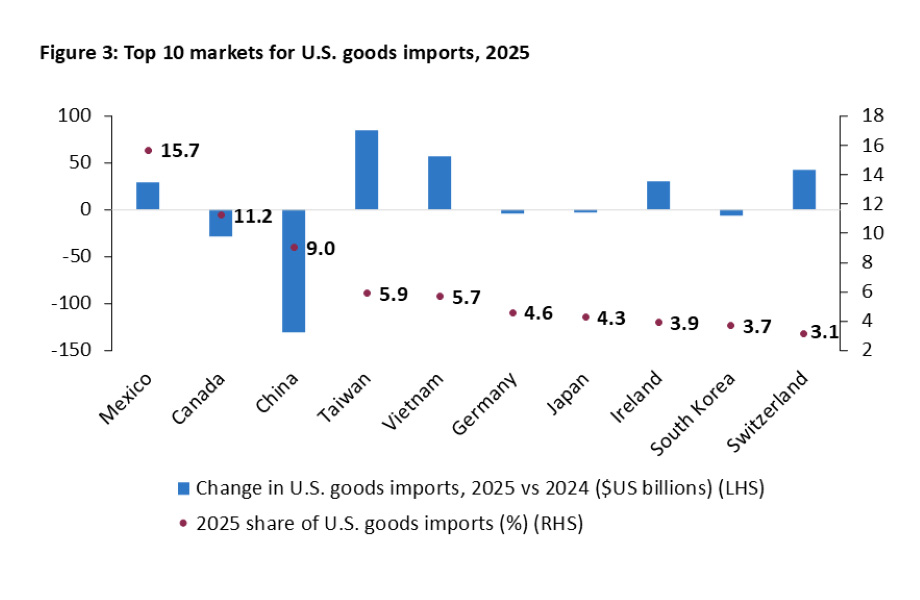
Note: These 10 countries accounted for two thirds of the U.S.’s 2025 goods imports.
Sources: U.S. Census Bureau, EDC Economics
Early 2026 data suggests tariff adjustments are still being felt most in Canadian manufacturing.
- Services support overall growth, but manufacturing remains under pressure: Over November 2025-January 2026, real GDP rose 0.9% y/y, largely driven by services (1.2% y/y). Manufacturing posted a sharp drop (-4% y/y), with steep drops in tariff-exposed segments: motor vehicles and parts (-7.6% y/y), wood products (-9.6% y/y), paper products (-10.4% y/y), primary iron and steel (-10.3% y/y) and alumina and aluminum production and processing (-17.7% y/y). Steel products manufactured from purchased steel were a notable exception, consistent with some domestic substitution.
- A similar divide is visible in the labour market: Employment growth over the past year was driven by services. Manufacturing lost 32,161 jobs between January 2025 and January 2026, particularly in motor vehicle parts (7,294 jobs) and other trade-exposed sectors.
- Early 2026 export performance reinforces the same message: Merchandise trade data for the first two months of 2026 show continued weakness in exports from tariff‑exposed manufacturing industries, especially motor vehicles and parts, steel and aluminum products, and downstream forestry products—most notably to the U.S. market.
These indicators point to a slowdown that remains concentrated in manufacturing, rather than broad-based across the economy.
Slower momentum across the U.S, Canada and Mexico reflects softer spending and rising costs.
A year on, Canada-U.S. trade hasn’t collapsed—but it has become more uneven. Most goods still qualify for duty-free access under CUSMA, yet sector‑specific measures continue to raise costs and uncertainty in manufacturing industries at the heart of cross‑border supply chains. Early 2026 indicators suggest these pressures persist.
For exporters, three signals are worth watching:
- Whether manufacturing job losses and GDP declines in autos, metals and forestry-linked industries begin to stabilize
- Whether business investment shifts from maintenance to expansion, signalling easing uncertainty
- Whether diversification efforts become broader-based, rather than driven by a narrow set of commodities
Tariff-related policy risk also remains elevated. In April 2026, the U.S. implemented a new tiered approach to Section 232 tariffs on steel, aluminum and select copper products, potentially raising costs for metal-intensive goods and further weighing on U.S. import demand—developments with clear implications for Canadian exporters.
EDC offers practical solutions to help Canadian businesses navigate uncertainty, from market intelligence to financing and risk management. Our experts provide guidance and connections to help exporters adapt, compete and grow in a complex global environment.
Here’s how we can support you:
- U.S. market intelligence: Access insights on the U.S. business environment.
- EDC’s Trade Impact Program (TIP): Launched in March 2025 as part of the Government of Canada’s $6.5-billion support package, TIP will facilitate an additional $5 billion until March 2027 for eligible companies.
- Export Help Hub: Connect with EDC trade advisors for market strategies, regulations and customs guidance.
- Business Connections Program: Promote your export capabilities to international buyers.
- Risk management tools: Explore financial solutions and resources, including the Country Risk Quarterly.
New to EDC? Take a quick assessment to see how we can support your business.
Already an EDC customer? Stay informed on U.S. market conditions and Canada-U.S. trade issues by contacting your EDC relationship manager or calling 1-800-229-0575