India’s trade agreements widen the gap for Canadian exporters
Author details
Nadeem Rizwan
Economist | Economic and Political Intelligence Centre
In this article:
With an almost US$4-trillion economy and a population of about 1.5 billion, India is impossible for Canadian exporters to ignore. As one of the world’s fastest-growing major markets—and a key economic player in the Asia-Pacific region—it offers significant opportunities for Canadian companies looking to grow internationally.
In November 2025, Canada relaunched negotiations toward a Comprehensive Economic Partnership Agreement (CEPA) with India, following other major economies that have also advanced or concluded trade agreements with India.
India’s Economic Cooperation and Trade Agreement (ECTA) with Australia and its Trade and Economic Partnership Agreement (TEPA) with the European Free Trade Association (Iceland, Liechtenstein, Norway and Switzerland) have been in force since 2022 and 2025, respectively. India has also signed free trade agreements with the United Kingdom (U.K.) and New Zealand (not yet in force), while negotiations with the European Union (EU) have concluded and are pending formal signing and ratification.
India is also advancing trade engagement with the United States (U.S.). The two sides have agreed to a framework arrangement. Taken together, these developments are reshaping the competitive conditions in the Indian market.
How do these agreements compare with Canada’s trade competitiveness in India’s market? A comparison with Australia, the U.K. and the EU shows how their agreements with India are changing Canada’s relative market access.
You should also check out
Insights and analysis from EDC to help plan your global expansion in the Asia-Pacific.
“India remains a high-potential market for Canadian exporters, but the competitive landscape is evolving quickly as more countries secure preferential access,” says Neil Krell, EDC’s chief representative in India. “For Canadian companies, staying competitive will increasingly depend on understanding where those gaps exist and adapting market strategies accordingly.”
India was the 11th-largest market for Canadian goods exports in 2025. But there’s still room to grow. Canada’s share of India’s goods imports declined marginally from 1.1% in 2017 to 0.9% in 2024, well below that of China (18.2%), the EU (6.9%), Australia (2.4%) and broadly in line with the U.K. (0.9%).
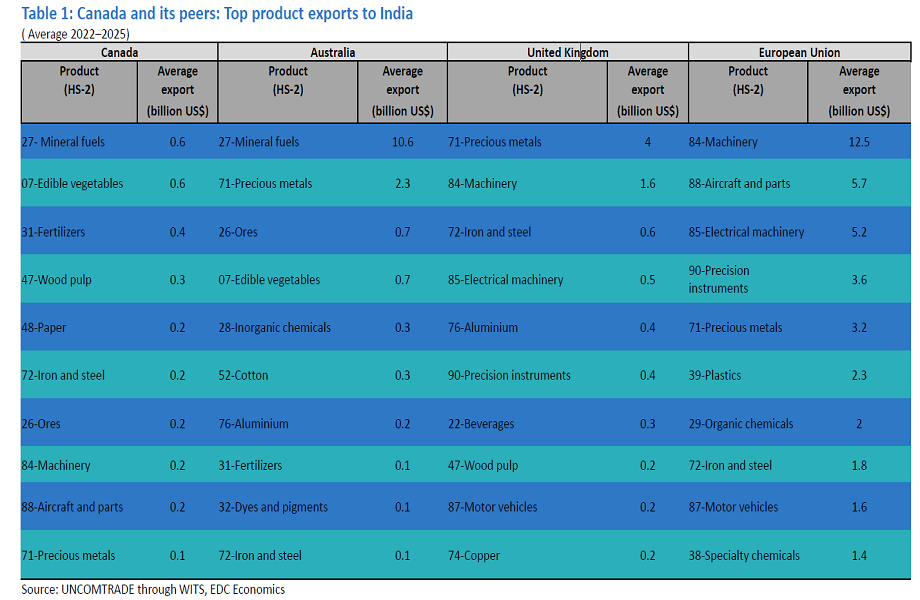
Post-pandemic, Canada’s merchandise exports to India are still mainly in commodities, including mineral fuels, agri‑food, fertilizers and forestry products. Canada competes most closely with Australia in resource‑based products, like energy, metals and agri-food. Its overlap with the EU and U.K. is smaller and mainly in machinery, aircraft and metals since their exports are more focused on manufacturing and technology. This shows Canada’s continued strength in resources and agriculture, but a smaller footprint in high‑value manufacturing compared to its European peers (Table 1).
Canada’s service exports to India have expanded rapidly, rising from about $2.2 billion in 2017 to $15.6 billion in 2024. However, Canada’s recent service export growth has been heavily driven by travel services linked to Indian students in Canada, which may slow due to recent immigration policy changes. Canada’s share of India’s services imports was approximately 3% in 2024, significantly lower than that of the U.S. (23.3%), which is the largest provider. Other key partners of India include the EU (around 17.9%) and the U.K. (6.8%), while Australia holds a similar share at 3.5%.
A common challenge for Canadian exporters in the Indian market is the high, complex and often unpredictable Indian tariff regime. According to the World Trade Organization (WTO), India’s average applied most-favoured-nation (MFN) tariff was 16.2% in 2024 and 36.7% for agricultural products.
Recent trade agreements with India aim to lower, or eliminate, tariffs on goods. Official announcements indicate that under the India–U.K. agreement, tariffs will be cut on about 90% of goods, with 85% becoming tariff-free within a decade. The India–Australia ECTA has eliminated tariffs on 85% of Australia’s goods exports, with another 5% to be phased out over the six years from entry into force. For the EU, reports suggest that close to 97% of goods will benefit from tariff cuts, or elimination, which will be phased in over a period of up to 10 years.
Although details vary by agreement, India continues to protect sensitive agricultural sectors such as dairy, meat (except sheep meat) and cereals. Agricultural gains are mainly in seafood (for Australia and the U.K.), processed agri‑foods, like bread, pastries and fruit juices, where tariffs are mostly removed or significantly reduced. Alcoholic beverages are subject to gradual tariff reductions rather than elimination. These cuts are meaningful given the very high starting tariff rates.
In non‑agricultural sectors—including machinery and electrical equipment, chemicals, pharmaceuticals, metals and minerals—tariff cuts are larger and happen faster. Transport equipment outcomes are more mixed: For the U.K. and Australia, aerospace gains are mostly limited to aircraft parts and components, while access for motor vehicles remains limited. For the EU, information suggests tariffs on finished aircraft will be gradually removed, while motor vehicles will get limited, quota-based access.
The trade agreements set out clear, internationally recognized rules to address food safety and animal and plant health requirements (sanitary and phytosanitary, or SPS), making regulations more transparent and helping exports move faster into India. They also encourage authorities to treat each other’s rules as “equivalent” when they provide the same level of safety, which can reduce duplicate checks and delays.
But these provisions don’t remove all SPS barriers, as Indian authorities retain the final decision and assesses cases individually. At the same time, customs procedures become simpler, with greater use of electronic paperwork, faster processing and clearer appeal options if problems arise at the border. Services trade also benefits from improved market access and transparency, including fair treatment and easier recognition of professional qualifications.
You should also check out
Insights on how international buyers assess suppliers and what drives demand in new markets.
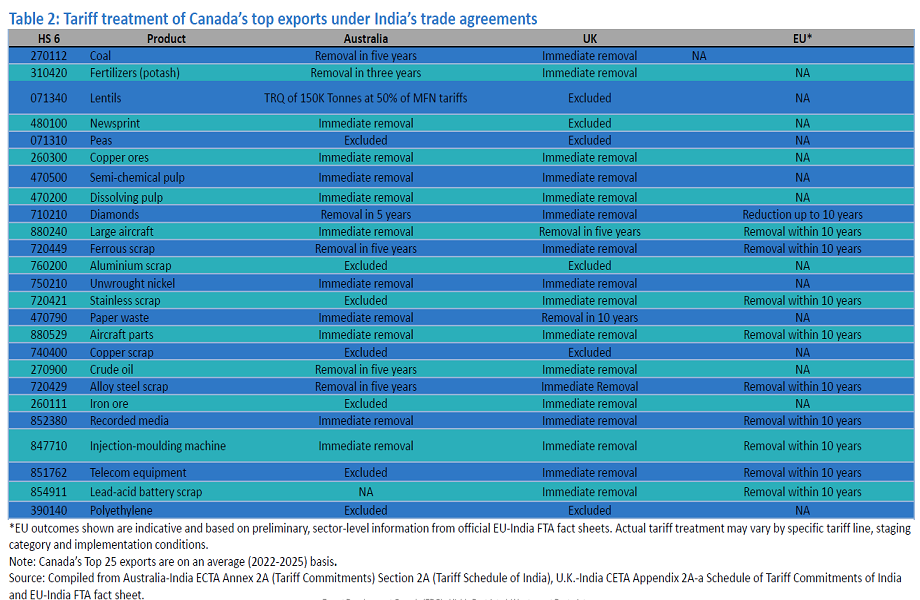
As other countries benefit from lower tariffs or preferential access under trade agreements, Canadian goods continue to face standard MFN tariffs (Table 2). This means exporters from other countries may be able to offer lower prices, or enter the market more easily, positioning them as preferred suppliers for Indian importers.
Lentils: A case study
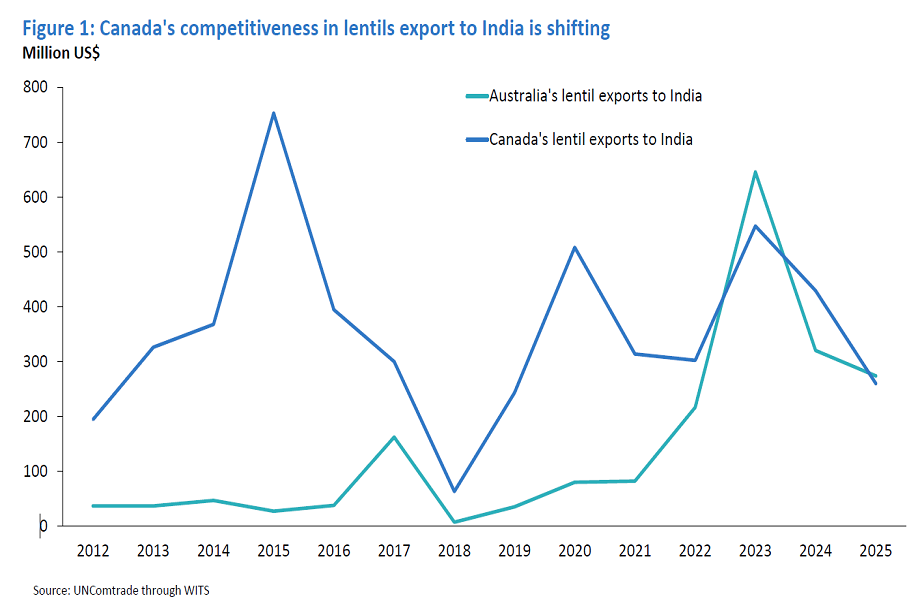
Australia’s lentil exports to India were modest compared to Canada until recent policy shifts. From October 2022 to March 2025, a temporary duty-free window benefited major non-U.S. suppliers, resulting in a surge in exports from both Canada and Australia. With the entry into force of the Australia–India ECTA in December 2022, Australia secured a quota, allowing a 50% reduction of the applied MFN tariffs on 150,000 tonnes of exports. When India reinstated a 10% tariff in March 2025, Australia retained preferential access under the quota, maintaining a cost advantage and stronger market access for its producers. In 2025, Australia’s lentil exports to India declined by only 2.9% from 2024, compared to Canada’s 24.2% drop; export values fell by 14.5% for Australia versus 39.5% for Canada.
SPS measures are often cited by Canadian exporters as an important issue when exporting to India. While trade agreements with other countries don’t completely eliminate these barriers, they provide clearer processes and institutional avenues to manage them.
Enhanced customs provisions offer more predictable and enforceable advantages, helping streamline procedures and reduce delays and uncertainty. Without comparable frameworks, Canadian exporters may remain exposed to less predictable SPS outcomes and slower border processes, placing them at a relative disadvantage. Competitors also benefit from earlier market access and regulatory positioning in services sectors through preferential entry conditions.
While some competitor countries currently benefit from early trade agreements, Canada brings long‑standing commercial ties, strong people‑to‑people connections and a well‑established reputation for quality and reliability in key sectors, including agri‑food, energy and advanced manufacturing.
Staying informed about evolving market conditions and competitor strategies will be critical to building on these strengths and deepening Canada’s presence in India.
Export Development Canada (EDC) has more than 20 years of in-market presence in India. We support exporters with market intelligence, advisory services and financing solutions to help them navigate regulatory complexity and strengthen their market position. For more on market conditions and trade opportunities, see EDC’s Doing business in India article.