Canadian mining in Latin America: Risks and opportunities
Author details:
Daniel Benatuil
Sr. country risk analyst | Economic and Political Intelligence Center
Karicia Quiroz
Economist | Country & Sector Intelligence
William Thomas
Senior Associate | Country & Sector Intelligence
In this article:
- Canada’s mining strengths at home and in Latin America
- Why Latin America matters for Canadian mining investment
- Latin America mining opportunities in copper, lithium and critical minerals
- Political risk in Latin America’s mining sector
- How mining risk has evolved—and where the opportunity is growing
- Why Canada and Latin America are a strategic mining fit
For more than three decades, Canadian mining firms have been among the most active foreign investors in Latin America and the Caribbean (LAC). Their presence goes beyond a leading footprint in producing assets and a significant stake in the project pipeline. It also supports Canadian exports of equipment, technology and commercial services across the broader mining supply chain.
As global demand for critical minerals accelerates and supply chain security becomes a strategic priority, Canada’s deep sector expertise and established regional presence will be important competitive strengths in the years ahead.
Key takeaways
- Latin America holds more than half of Canada’s global mining assets abroad.
- The region is critical for copper, lithium and other minerals tied to electrification.
- Political risks are shifting from nationalization toward regulatory and social pressures.
- Opportunities remain strong but vary significantly by country and commodity.
- Canadian firms benefit from strong expertise in financing and environmental, social and governance (ESG) practices, and mining expertise.
Canada is a leading global mining jurisdiction. It produces more than 60 minerals and metals and ranks among the Top 5 global producers of potash, gold, aluminum, nickel, uranium and platinum group metals (PGMs). Canada’s critical minerals strategy focuses on expanding production and selectively building processing and refining capacity to strengthen its role as a reliable supplier to global industrial, energy and strategic markets such as defence. Canada is also a global hub for mining finance and expertise, hosting more than 40% of the world’s listed mining and exploration companies and supported by a strong mining equipment, technology and services (METS) ecosystem.
With more than two-thirds of Canadian mining assets (CMA) located abroad, Canada’s mining sector naturally extends domestic capital, expertise and partnerships into key foreign mining regions—particularly in LAC. Canadian direct investment abroad (CDIA) also supports domestic economic activity through exports, investment income and enhanced competitiveness, underscoring the broader economic value of Canada’s mining investment in LAC.
You should also check out
Energy shocks and geopolitical risk are testing global resilience. What it means for growth, trade and Canadian exporters—and how EDC’s Global Economic Outlook can inform market planning.
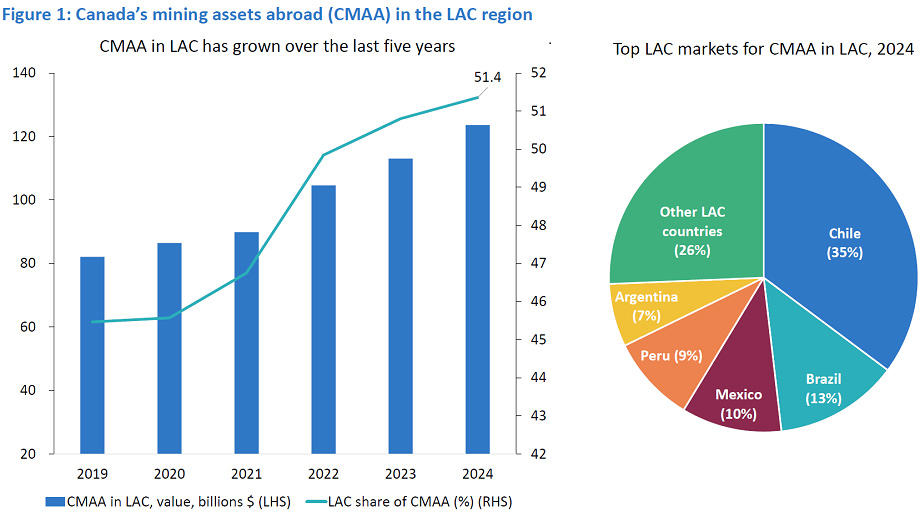
Canada is one of the world’s largest mining investors. Canadian mining assets abroad (CMAA) reached $240.6 billion in 2024, with 51% located in the LAC region ($123.5 billion). Excluding Canadian assets in the United States, the LAC share rises to 64%, highlighting the region’s importance in diversifying Canada’s global mining exposure (Figure 1). Chile, Brazil, Mexico, Peru and Argentina account for nearly three-quarters of Canada’s total mining investment in LAC.
Source: Natural Resources Canada/EDC Economics. Numbers may not add up to one as they’re rounded. See Canadian Mining Assets—Natural Resources Canada for further information.
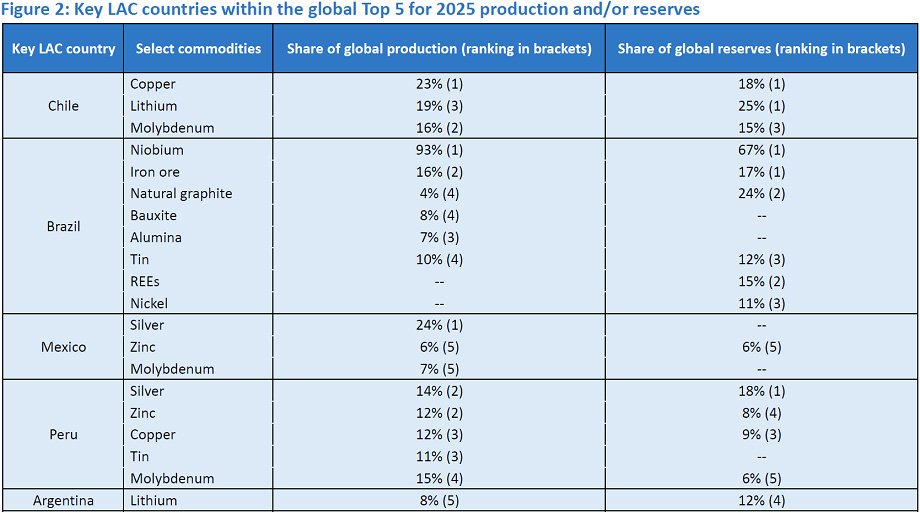
LAC plays a central role in global minerals and metals markets, combining large-scale production with significant reserves to meet current and future demand. Several countries rank among the Top 5 global producers of copper, lithium, molybdenum, silver, zinc, tin, niobium, iron ore, bauxite and alumina. Some also hold major reserve advantages, notably Brazil for rare earth elements (REEs), which has the second-largest reserves after China (Figure 2).
Sources: U.S. Geological Survey (USGS), Mineral Commodity Summaries 2026/EDC Economics. Production and reserve shares and rankings reflect 2025 reported estimates. Reserves refer to economically recoverable quantities using current technology and prices. Select commodities (not exhaustive) shown for Canada’s Top 5 LAC markets by 2024 CMAA. For iron ore, production is measured on a usable ore basis, and reserves are reported in contained iron content (Fe) to ensure cross-country comparability.
Copper remains the region’s dominant growth driver, supported by scale, established production capacity and sizable reserves. Chile and Peru together account for 35% of global output, underscoring the region’s role in meeting demand tied to electrification and the energy transition. Lithium is also gaining importance, with Chile and Argentina among the world’s leading producers and reserve holders.
Beyond these commodities, the region also holds strong positions in a range of industrial metals, including molybdenum, zinc, tin and niobium, highlighting the breadth of its mineral endowment. Precious metals—particularly, gold and silver—also remain important sources of export earnings.
High-volume commodities such as iron ore, bauxite and alumina are also produced at scale, while critical minerals, including nickel, REEs and graphite, represent longer-term growth opportunities as projects advance from exploration to development.
However, structural constraints will shape outcomes. The region remains oriented toward primary commodity exports, with a significant share going to Asia, especially China, and limited processing capacity. Mining investment is also capital‑intensive and long‑cycle, while infrastructure and permitting constraints can delay project development.
Overall, opportunities are significant, but uneven across countries, commodities and projects.
How mining risks in Latin America are changing
Political risk in mining can be grouped into three main categories:
- Expropriation or government interference (Expro) risk refers to government actions that strip a project’s value or ownership—such as nationalization, impactful tax adjustments, or changes to permits and contracts.
- Political violence (PV) risk captures disruptions, like protests, blockades and unrest, that interrupt operations and supply chains.
- Transfer and convertibility (T&C) risk arises when companies face restrictions moving money out of a country, including limits on access to foreign currency, or profit repatriation.
Political risk in LAC’s mining sector has evolved considerably over time, alongside shifting commodity cycles and policy priorities. For much of the 20th century, risk centred on labour unrest, resource nationalism and direct state intervention. Market liberalization in the 1990s, combined with rising global demand, drove foreign investment and enabled Canadian firms to establish a strong regional presence.
This model began to fray during the 2003–2013 commodity boom, as populist governments—responding to redistribution pressures—pursued resource nationalism through higher royalties, windfall taxes and tighter regulation. By the 2010s, environmental concerns, including water scarcity and contamination, alongside Indigenous land rights, brought social licence to the forefront.
After commodity prices fell in 2014, government revenues and support tightened, while underlying tensions over benefit sharing and environmental impacts intensified—contributing to renewed Expro and PV risks.
For Expro, Panama is the clearest recent example, where the closure of the Cobre Panama mine in 2023—following a Supreme Court ruling that invalidated its contract—effectively removed one of the country’s largest mining investments. Similarly, though less direct, pressures have emerged in Chile and Peru, where royalty changes and permitting uncertainty have weighed on project profitability and investor confidence.
At the same time, PV risks have also increased, with Peru and Chile experiencing a sharp increase in mining-related conflicts between 2000 and 2020, contributing to repeated operational disruptions.
While T&C risk is less prevalent in the LAC region, it’s been a concern in certain markets, as seen in Argentina’s foreign exchange (FX) controls and capital restrictions between 2019 and 2025, which constrained profit repatriation, debt servicing and access to imported inputs.
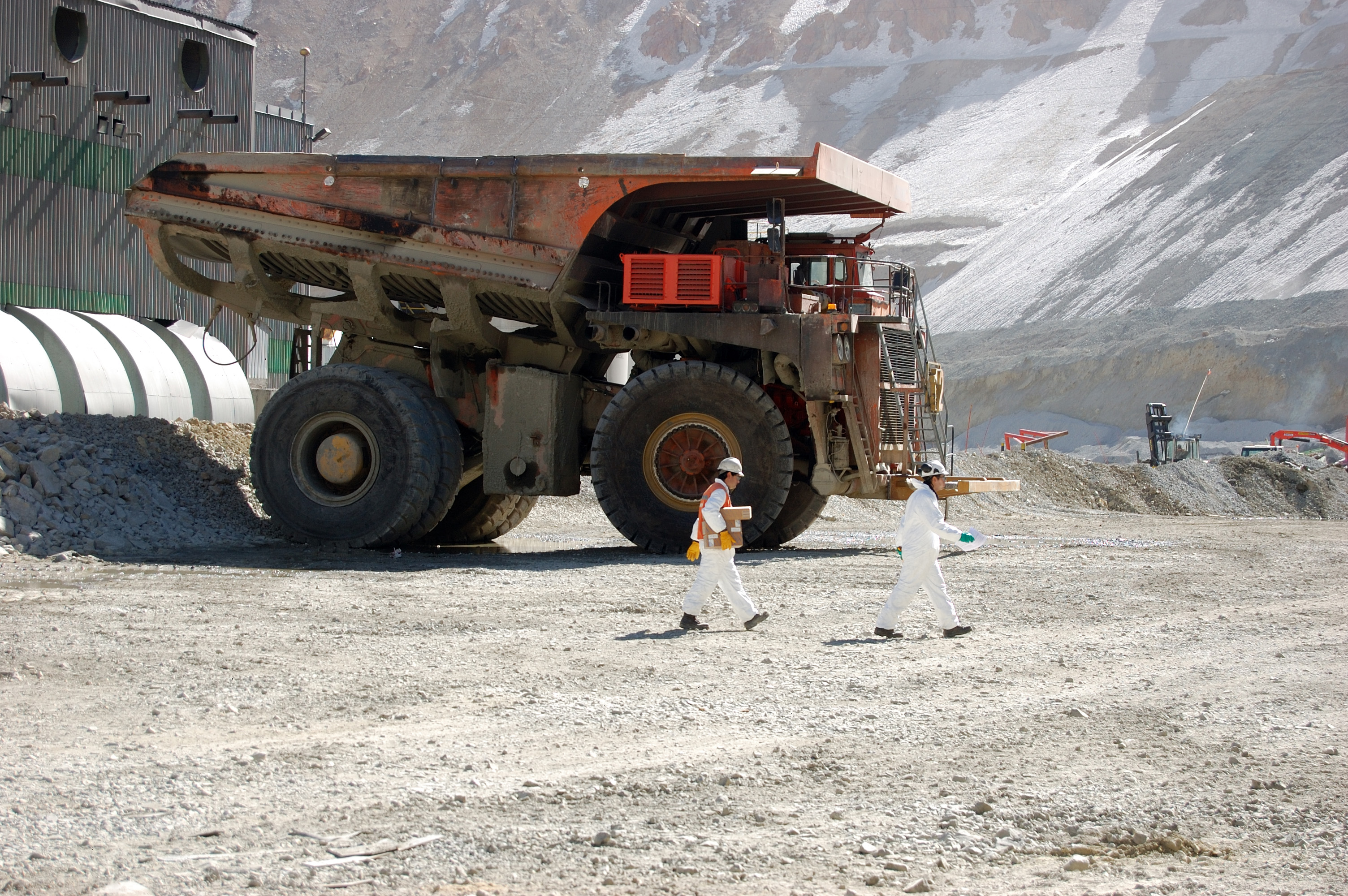
Two miners walk past a large haul truck at a copper mine in Chile.
Despite these risks, key LAC mining jurisdictions still compare favourably against many other mining jurisdictions globally, with lower levels of perceived resource nationalism and political risk. Even as pressures increase, risks have also become more nuanced across countries: Chile combines strong institutions with stringent environmental rules; Peru remains geology-rich, but socially and politically volatile; Brazil pairs scale with regulatory complexity; Mexico’s potential is hindered by regulatory uncertainty; and Ecuador and Argentina offer greenfield upside, but demand robust political risk mitigation frameworks.
Importantly, the political-extractives cycle is turning again. Tight supply and rising demand for critical minerals are creating windfall revenues for producers and governments, driving renewed interest in developing the region’s resource potential amidst a context of sluggish economic growth and fiscal strain.
Many countries are adopting—or considering—long-term critical minerals strategies. Some are reversing past policies (e.g., Panama is debating whether to reopen its large copper mine), while others are pursuing hybrid or partial approaches, through sector laws, mapping and project-focused measures.
On the political front, the region’s recent political shift in key markets could ease regulatory and tax pressures, while upcoming elections this year in Peru, Colombia and Brazil could contribute to this trend. LAC’s ongoing political cycle will define how key mining jurisdictions address persistent mining risks and support the region’s appeal for mining investment, which is critical for Canadian investors with established interests in the region.
Overall, political risks in LAC mining have become more complex and closely tied to governance and social dynamics, but they remain manageable and increasingly differentiated across markets. This reinforces the need for Canadian investors to adopt tailored, country-specific risk strategies.
According to Christian Daroch, Export Development Canada’s (EDC) senior regional manager for Chile, Latin America remains a cornerstone for Canadian mining investment, offering both scale in critical minerals and established partnerships across key markets.
“While countries, like Chile, anchor the region with strong institutions and deep mining expertise, opportunities extend across Latin America for Canadian firms that bring technology, services and a long-term, responsible approach to project development.”
Stephen Goodman, EDC’s ecosystem lead for critical minerals and infrastructure, adds: “For Canada’s mining ecosystem, Latin America is a strategic anchor internationally, pairing critical mineral scale with a history of stable, constructive engagement that continues to support Canadian investment, expertise and long-term partnerships.”
Canada-LAC mining relations are a mutually beneficial partnership. LAC benefits from Canada’s financing, technical expertise and mining ecosystem, including METS firms, while Canada’s economic security and supply chains increasingly rely on LAC’s mineral endowment and project pipeline.
A clear example is aluminum: Canada doesn’t mine bauxite domestically and relies on imported bauxite and alumina—much of it sourced from countries such as Brazil—to support its smelting capacity, particularly in Quebec. This highlights how upstream supply from LAC underpins one of Canada’s key industrial sectors.
Canada’s advantage lies in its integrated mining ecosystem—capital markets, project finance, engineering know-how and ESG practices—which supports project development in complex environments. These capabilities are particularly relevant as project viability depends on social licence, regulatory alignment and long development timelines.
Canadian strengths in community and Indigenous engagement, governance and environmental management (i.e., water stewardship and tailings safety) are key differentiators in LAC. The growing adoption of Canadian-origin frameworks such as the Mining Association of Canada’s Towards Sustainable Mining (TSM) reflects demand for credible, auditable standards that build trust across communities, regulators and investors.
For Canada, LAC plays an important role in supply diversification and resilience, given its position in addressing rising demand linked to electrification, advanced manufacturing, digital technologies and defence. However, a shared constraint remains: Limited processing capacity in the hemisphere. Even when minerals are mined in the Americas, midstream processing is often concentrated elsewhere—particularly in China. Building new smelters and refineries is complex and capital-intensive, with long timelines, tighter ESG requirements and challenging economics that can constrain financing. That said, progress is emerging, including new copper smelting projects under development in Chile.
In short, the Canada-LAC partnership is highly complementary. Canada brings capital, expertise and globally recognized standards, while LAC provides scale in minerals needed by the world. The key gap remains moving beyond extraction toward greater processing and value capture—an objective both regions are working to advance.
How Canadian firms can grow in Latin America’s mining sector
Canada’s long-standing engagement in LAC’s mining sector has built deep expertise and strong commercial relationships. It also stands out as a clear diversification success: By supporting CMAA growth, higher CDIA in Latin America’s mining sector can generate positive economic spillover effects through exports, investment income and competitiveness.
The next mining growth phase will reward firms that recognize three realities:
1. Mining is increasingly shaped by policy, climate and social factors.
2. Risks are institutional and relational, not just geological.
3. Diversification across markets, supply chains and partnerships is critical.
As global competition intensifies—from U.S. industrial policy to China’s integrated supply chains and Europe’s climate-driven strategy—Canada’s ability to leverage its regional presence and ecosystem strengths will be key to boosting its competitive edge and supporting future investment and export growth opportunities EDC’s market expertise, financing solutions and Business Connections Program can support Canadian firms in translating this strategic positioning into durable commercial success.